Professor Shinohara of Tohoku University, Japan, has kindly agreed to let me join his group for a long visit. This is exciting, and the opportunity of a lifetime, but it also throws up some uncomfortable facts about how I see myself and the things I do to cope with the limits of my competence.
Coming from a chaotic family background, competence has always been hugely important to me. I've not minimised its importance by choosing to work as a woman in a male dominated discipline. Jorge Cham sums up pretty much how I feel most of the time in this strip: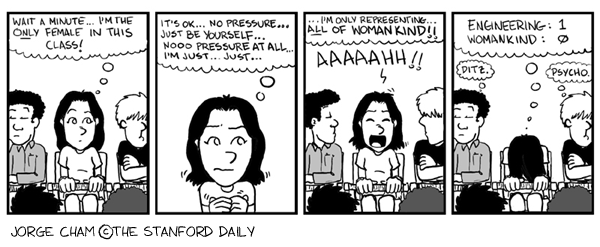
Ever since school reports I've been described as "dilligent", "studious", "competent" and "enterprising". Solver of problems. Learner of things. Nose in a book, head in the air, feet on the ground.
So working in Japan for a month is going to be a huge challenge for me on a personal as well as a practical level. Regular readers will have noticed that I'm already trying to prepare. I'm learning as much Japanese as I can, downloading street maps, buying city guides and pumping every Japanese person I meet for data.
It's starting to dawn on me that being able to control my environment by knowing everything about it will be impossible. At some point in the next four weeks this has to stop, as it's more than bordering on an obsession.
My drive for competence has - not for the first time - reached its limit. This time, however, I'm going to try something new. I'm going to try letting myself be incompetent. Get in the Onsen the wrong way? Embarrassing sure, but really the end of the world? Use "Taberu" not "Tabemasu"? No-one will be rendered catatonic by my breach of etiquette.
And yet the mere thought of these faux pas is enough to render me clammy handed and weak legged. The thought of being incompetent is bad enough. The though of being the incompetent representative of womankind is enough to give me the screaming abdabs. I'm sent rushing back to Google, the Rough Guide and the friendly waitress in the Japanese restaurant.
I forever miss the moment because I've rehearsed it so many times, in order not to get it wrong. If I could unleash my incompetence, how liberating would it feel?
scientiae-carnival
Wednesday, August 22, 2007
Unleashing my incompetence

Learning Japanese: 見せしめ 四
(Miseshime Shi/Lesson Four)
Last night David and I went to Hazuki Japanese restaurant.
I tried とんかつ (tonkatsu - deep fried beef), which was nice. But my favourite were the (considerably healthier!) nigiri (にぎり). Nigiri sushi are the little "bricks" of vinegared rice with a small fillet of raw fish laid on top.
Our incredibly helpful waitress supplied the Japanese names and the Kanji of the two fish that I ate. She helpfully explained that the names for most of the fish are rarely written out in Kanji, as they all contain the Kanji for fish (魚) and thus get quite complicated quite quickly. Salmon is an exception - the kanji is 鮭, and is said 'sake'.
The two nigiri I particularly enjoyed were the 'horse mackerel' and the 'eel'.
Horse mackerel: Aji - あじ - 鯵
Eel: Unagi - うなぎ - 鰻
Hazuki's menu helpfully lists all the names of the dishes in katakana/kanki as well as english. I'll be printing this out to take with me - and I may have a few more "practice runs" there before we go. I take my research very seriously you know...
Monday, August 20, 2007
Needles(s) activity
I decided to teach myself how to knit - relying heavily on the people at Knitting Help to find out how to cast on nicely. The reason? Innocent's Big Knit in aid of Age Concern. It's amazing - I've gone from never having touched a pair of knitting needles (or at least not since the jumbo sized ones you're made to play with in infant school "craft" lessons) to knocking up 2 small hats per evening.
Here are a few of my creations so far (now in blurryvision!):
But it's time to move on to bigger projects. I've already knitted myself an i-Pod Nano case in fetching lilac and purple. But David is now asking for something he saw over at Aphra Benn's place:
How to knit a Moebius scarf from the middle to the edge.
I'll start that when I've decided I've done enough hats.
And after that, brains..?
Monday, August 13, 2007
Learning Japanese Part 3
Part 2 of this series of my notes on learning Japanese introduced verbs and the formal and informal present tense inflections. I've also been learning the past tense.
Remember that all uninflected verbs end in a u:
書 to write Kaku (かく)
考 to think Kangaeru (かんげる)
来 to come Kuru (くる)
There are three "forms" of verbs.
1) Irregulars: of which there are only two: 来 and する (suru - to do)
2) All others ending in "ru": 考
3) All the rest: 書
Here's how to make the past participle of these verbs:
1) Formal: 来 becomes 来ました ("kimashita"); する becomes しました
1) Informal: 来 becomes 来た ("kita"); する becomes した ("shita")
2) Formal: -ru, +mashita: 考 becomes 考えました ("kangaemashita")
2) Informal: -ru, +ta: 考 becomes 考えた ("kangaeta")
3) Formal: -u, +imashita: 書 becomes 書きました ("kakimashita")
3) Informal: Now it gets trickier.
3i) if the verb ends in "ku", -ku, +ita (書 becomes 書いた - "kaita")
3ii) if the verb ends in "gu", -gu, +ida :
急 (いそぐ "isogu", hurry) becomes 急いだ ("isoida")
3iii)if the verb ends in [nu|bu|mu], -[nu,bu,mu], +nda
学 (まなぶ ”manabu"、learn) becomes 学んだ ("mananda")
3iv) if the verb ends in "su", -su, +shita
試 (ためす ”tamesu”, to experiment) becomes 試した("tameshita")
3v) all other "u" and "tsu", -[u|tsu], +tta
立っ (たつ "tatsu", stand) becomes 立った ("tatta"). Note that the つ ("tsu") character in the uninflected verb is not removed - it becomes the first "t" in った ("tta").
These forms are the same for all "persons" - that is, "I have written" is is "kaita" or "kakimashita". But "you have written" is also "kaita" or "kakimashita"
Friday, August 10, 2007
Learning Japanese, I really think so - part 2
Hurrah - it's official. Professor Shinohara of Tohoku University has kindly agreed to let me come for an academic exchange visit in October. I will join is group for a few weeks, which is an exciting, if somewhat terrifying, prospect. Rob seemed to enjoy the perplexity of the whole experience. Learning a little Japanese would, it seems, be essential.
So today let's look at verbs and versions of the present tense. It seems that things are a lot more straightforward than I'd feared.
All uninflected verbs end in a "u":
飲 to drink Nomu (のむ)
食 to eat Taberu (たべる)
来 to come Kuru (くる)
There are three "forms" of verbs.
1) Irregulars: of which there are only two: 来 and する (suru - to do)
2) All others ending in "ru": 食
3) All the rest: 飲
Among "informal' company, the present tense is simply the uninflected form of the verb. In more polite situation, the verb ending changes according to one of the following rules:
Type 1: These become "kimasu" (来ます) and "shimasu" (します) respectively
Type 2: Drop the "ru" and add add "masu": 食ます = tabemasu: I eat - politely ^-^ )
Type 3: Drop the "u" and add "imasu": 飲います = nomimasu: I drink, politely)
Next up - the past tense: in which we learn that there are seven rules for informal speech and only three for formal speech. This leads to a shaky hypothesis about why the Japanese tend to politeness.
Thanks to Amanda (アマンダ) and this webpage by Namiko Abe.
Thursday, August 09, 2007
Writing in Japanese fonts on OSX
In an earlier post I talked about the three Japanese character systems. Writing in Hiragana and Katakana is good practice for learning the sounds and vocabulary of Japanese. Here's how to do it on OSX:
- Go to system preferences: international: input menu
- Tick the Kotoeri check box, and the "show input menu in menu bar" box
- You'll see a little flag or icon in the menu bar - clicking on this brings up the list of available input types
- Select "Hiragana" or "Katakana". Each time you type a valid phoneme ("ka", "ta", "e","ni"...) it is automatically changed to the Hiragana or Katakana character.
So my name, in Katakana, is: エマ
The Knights who say "Ni" are the Knights who say ニ
And so on...
With love from アンチエム
Kilometre-stone
I'm measuring my runs in kilometres cause it feels so much, well, more than in miles, and today, after 68 runs, my Nike+ dohickey gave me the following
A pretty 250 KM certificate.
Still time to sponsor my 5k run for Cancer Research. Thanks to fantastic friends and family I'm now at 122% of my target, but the more we can raise for Cancer Research the better, so don't let that put you off.
Wednesday, August 08, 2007
Learning Japanese - I really think so
I am trying to learn Japanese (there's a reason - I'll explain some other time). I know the "Romaji" (romanised spelling) of some common Japanese words ("konnichiwa", "domo arigato mister roboto", that kind of thing). But a ma-hoosive impediment to getting any further is not understanding any of the several written forms of Japanese. So I'm teaching myself the Hiragana - the phonetic "alphabet" for anything other than common names (which have a different alphabet of their own).
Note that these symbols are not related to the Chinese derived "Kanji", which my reading tells me have, usually, at least two readings - a Chinese derived pronunciation (or pronunciations) called "On'yomi" and a reading derived from the original pronunciation of that word in Japanese called "Kun'yomi". The different readings are given in Hiragana in dictionaries, so knowing Hiragana is a huge advantage to learning what the Kanji mean, or at least how they are said.
Hiragana are also used for the "grammar" of Japanese, so I'm told. So learning these, and some basic vocab, is my first task.
Thankfully there are a small number of Hiragana and each maps to a Japanese phoneme. This is the first bit of good news I've had since deciding to learn some Japanese!
Here are today's words and the relevant Hiragana:
ありがとうございます (arigato gozaimasu: "thank you" from this online dictionary)
あ a
り ri
が ga
と to
う u
ご go
ざ za
い i
ま ma
す su
こんにちは (konnichiwa - written konnichiha: "hello". Literally means "today is".
こ ko
ん n
に ni
ち chi
は ha
ごくろさまでした (gokurosama deshita: "Thank you for your help" (lit: it must have been a toil))
ご go (note the "Daku-ten" accent (looks like a ") that turns "ko" into "go")
く ku
ろ ru
さ sa
ま ma
で de (another daku-ten - changes "te" to "de")
し shi
た ta
ごくろさま (gokurosama = it is a toil)
でした (deshita = past participle)
じゃまた (ja mata: see you later (from these useful lessons))
じゃ ja (the Hiragana for ji (じ) - which is in turn a shi (し) and a ", and a little version of the Hiragana for ya (や))
ま ma
た ta
せんせい (sensei: teacher or other highly placed professional - literally "one who lived before". From Wiktionary
せ se
ん n
せ se
い i
I still don't know how to punctuate or capitalise. Do such things exist? Any help appreciated!
'Til next time, ありがとうございます and じゃまた
Monday, August 06, 2007
Tuesday, July 31, 2007
From now on, every post comes with onion rings
At work I keep getting emails about this allegedly amazing new programming language called Ruby. "Try it", they say, "All the cool kids are doing it". But I worry, is it a gateway language? Will I be scripting Perl in a chichi little cybercafe in Hoxton by autumn? Will winter see my slow decline as I'm turning tricks in VB? <shudder>
And then I found The Poignant Guide to Ruby. And I was seduced. To the dark side or to the light I know not - I haven't actually learnt any Ruby yet... but the first three chapters hasve made me laugh out loud a coupla times. More than I can say for, "C++: the Core Language*".
Instead of Hello World we begin with:
"Like when you meet Somebody in college and they look like somebody who used to hit you in the face with paintbrushes when you were a kid. And so, impulsively, you conclude that this new Somebody is likely a non-friend. You wince at their hair. You hang up phones loudly during crucial moments in their anecdotes. You use your pogo stick right there where they are trying to walk!"
(
Or you could learn LOLCode. That rocks too.
*Srsly - the O'Reilly books rock. Buy them if you want to live.
Wednesday, July 25, 2007
UK PLC - Your R&D department needs help.
On the day that Alistair Darling proclaims that UK PLC is open for business, the Today program (Real Audio) reports that, for the want of investment that was promised in 2005, the UK lead in stem cell therapies is slipping.
To summarise: the unfavourable political climate in the US has lead to an influx of overseas researchers to the UK. However, the startup investment in this research promised two years ago by the UK government has not been delivered. Meanwhile, US Biotech companies are gearing up to take advantage of the expected softening in the stance on stem cell research in the US that will come after the 2008 presidential elections. It looks like the lucrative technologies resulting from this research will eventually be patented not by UK researchers, but by US private companies. Regardless of one's position on a) stem cell therapies and b) patents, and intellectual property in general, it's poor business practice on the part of UK PLC to surrender its competitive advantage in this field without a fight. Yet short sighted cuts in the science budget show just how little UK PLC values its R&D department.
Monday, July 23, 2007
Little Bro still in one piece...
People who know me probably know that my kid brother is working on the St Pancras renovation. Just spoken to him and he promises me that this was not his fault! AFAHK everyone is fine, and a few people are likely to be in for a bit of double bubble to patch up the mess.
Saturday, July 21, 2007
The personality defect test
I saw this over at Dr Joan's. I was feeling a bit smug about my "Personal DNA" profile, so I needed the dash of chilled salt-water in the face that the Personality Defect test provides.
Keep in mind that I have a cold right now. I think that on a less mucus-y day, I think I'd more likely be a haughty intellectual. But until this bug goes away, be warned:
Your Score: Sociopath
You are 100% Rational, 28% Extroverted, 57% Brutal, and 71% Arrogant.

You are the Sociopath! As a result of your cold, calculating rationality, your introversion (and ability to keep quiet), your brutality, and your arrogance, you would make a very cunning serial killer. You are confident and capable of social interaction, but you prefer the silence of dead bodies to the loud, twittering nitwits you normally encounter in your daily life. You care very little for the feelings of others, possibly because you are not a very emotional person. You are also very calculating and intelligent, making you a perfect criminal mastermind. Also, you are a very arrogant person, tending to see yourself as better than others, providing you with a strong ability to perceive others as weak little animals, so tiny and small. You take great pleasure in the misery of others, and there is nothing sweeter to you than the sweet glory of using someone else's shattered failure to project yourself to success. Except sugar. That just may be sweeter. In short, your personality defect is the fact that you could easily be a sociopath, because you are calculating, unemotional, brutal, and arrogant. Please don't kill me for writing mean things about you! I have a 101 mile-long knife! Don't make me use it!
To put it less negatively:
1. You are more RATIONAL than intuitive.
2. You are more INTROVERTED than extroverted.
3. You are more BRUTAL than gentle.
4. You are more ARROGANT than humble.
Compatibility:
Your exact opposite is the Hippie.
Other personalities you would probably get along with are the Spiteful Loner, the Smartass, and the Capitalist Pig.
*
*
If you scored near fifty percent for a certain trait (42%-58%), you could very well go either way. For example, someone with 42% Extroversion is slightly leaning towards being an introvert, but is close enough to being an extrovert to be classified that way as well. Below is a list of the other personality types so that you can determine which other possible categories you may fill if you scored near fifty percent for certain traits.
The other personality types:
The Emo Kid: Intuitive, Introverted, Gentle, Humble.
The Starving Artist: Intuitive, Introverted, Gentle, Arrogant.
The Bitch-Slap: Intuitive, Introverted, Brutal, Humble.
The Brute: Intuitive, Introverted, Brutal, Arrogant.
The Hippie: Intuitive, Extroverted, Gentle, Humble.
The Televangelist: Intuitive, Extroverted, Gentle, Arrogant.
The Schoolyard Bully: Intuitive, Extroverted, Brutal, Humble.
The Class Clown: Intuitive, Extroverted, Brutal, Arrogant.
The Robot: Rational, Introverted, Gentle, Humble.
The Haughty Intellectual: Rational, Introverted, Gentle, Arrogant.
The Spiteful Loner: Rational, Introverted, Brutal, Humble.
The Sociopath: Rational, Introverted, Brutal, Arrogant.
The Hand-Raiser: Rational, Extroverted, Gentle, Humble.
The Braggart: Rational, Extroverted, Gentle, Arrogant.
The Capitalist Pig: Rational, Extroverted, Brutal, Humble.
The Smartass: Rational, Extroverted, Brutal, Arrogant.
Be sure to take my Sublime Philosophical Crap Test if you are interested in taking a slightly more intellectual test that has just as many insane ramblings as this one does!
About Saint_Gasoline
I am a self-proclaimed pseudo-intellectual who loves dashes. I enjoy science, philosophy, and fart jokes and water balloons, not necessarily in that order. I spend 95% of my time online, and the other 5% of my time in the bathroom, longing to get back on the computer. If, God forbid, you somehow find me amusing instead of crass and annoying, be sure to check out my blog and my webcomic at SaintGasoline.com.
| Link: The Personality Defect Test written by saint_gasoline on OkCupid Free Online Dating, home of the The Dating Persona Test |
Monday, July 16, 2007
Expanding Mind, Expanding Horizons
I'm back in the office after last week's stint at GECCO. Trying hard to hold on to the sense of mind-expanding excitement that I got from the talks and the excellent tutorials. I learnt that:
- I really like the theory side of things - seems like my PhD training hasn't entirely left me
- That it is possible for robots to learn their body plans and adapt when damaged
- That a novel way of evolving Neural Nets, based on Gene Regulatory Networks, leads to an excellent Nothello player
- That it is [PDF] possible to evolve cool towers - but that a smaller genome seems to be better when it comes to trying to transfer between environments.
It's also time to start looking for new jobs as my the current contract is rapidly drawing to a close. A funding proposal I've been working on alongside, let's call him "possible future boss" (PFB), went in last week. I'm more excited, and less sanguine, than I was even for my Viva.
Just before the proposal was submitted, I was invited to PFB's group meeting: some of the PFB's PhDs and postdocs were also at GECCO and related events, so discussions (and cakes) were in planned. I felt like I was going to an interview, or at least the parts of the interview that everyone claims aren't an interview but you know are really. I have links with someone in the group already, so I thought that it was important to prove that I wasn't just going to play well with my "special friend", that I could actually work with the whole team. As soon as the meeting started I realised that wouldn't be a problem: the group is stuffed with brilliant, argumentative, interesting, insatiably curious people. And I don't think any of them read this blog, so I promise I'm not sucking up.
Afterwards, I had a final proof read of the proposal before submission (my first late night at the office!) and was struck again by the fact that it would be a fantastically exciting project to work on, and that I had just met an excellent group of people that I'd be thrilled to work with. But it's out of our hands until the reviews come in. The committee that will decide my fate don't meet 'til November, so I won't know if the money's ours until January. Waiting is the hardest part[1].
[1] In fairness, getting on top of a new discipline's literature in my spare time was the hardest part - but the waiting is a close second.
Friday, July 06, 2007
Stop. GECCO time.
I'm off to GECCO (and to see the husband) tomorrow. I'll try to bring some highlights of general interest over the next few days - conference fatigue permitting. Your favourite auntie will also be plying one of the mics at the Jones/Dawkings/Wolpert event, but I'll try to stay alert enough to bring some highlights from that too. In the meantime you could satisfy your Prof. Steve Jones requirements with an old post.
Friday, June 29, 2007
She's mad as hell and she's not going to take it any more...
A non-science Heroine of the day:
On the 27th June, the producer of MSNBC's "Morning Joe" show decided to lead with the story of a certain celebutante's release from chokey. This on the same day that Republican Senator Richard Lugar decided to defy President Bush on the Iraq war. News anchor Mika Brzezinski does not want:
Mika: "I have an apology as well, and that is for our lead story... I didn't choose it... I hate this story and I don't think it should be our lead ... move the prompter, thank you, alright, to the news now."
and later, as the male anchor (the eponymous "Joe"?) concludes his talking points about the senate and the house of representatives pressuring Bush to scale back the troops in Iraq, Mika begins her news rundown with:
"Well, you'd think we'd be leading with that story."
Go Mika!
Saturday, June 23, 2007
"The name of the page has been changed"
Or why the word "quack" seems to have been adjudged to be inflammatory.
The ever bombastic pharmacology Professor David Colquhoun has been running a "quackery" blog for some time. In it he takes on the purveyors of such woo-woo as "blood cleansers" and "magic water". His posts are less readable than the taut prose of Ben Goldacre, and he can get even more frothing than James Randi. What he says about pseudoscientific quackery, a multi-billion pound industry which preys on ignorance and fear, is ill-tempered but well founded.
Recently, the husband of one of these placebo-mongers launched a "kitchen sink" legal action which, according to Colquhoun and UCL provost Malcolm Grant, included: allegations of defamation, malicious falsehood and breach of copyright; enquiries under the FOI and a demand that "a paper [be] circulated to all UCL Council members concerning an alleged misuse of IT resources and possibly office space and secretarial facilities by Professor Colquhoun". UCL, in what must be conceded was a responsible, if ass-covering, move requested Colquhoun's blog be shelved whilst a QC was summoned to give advice.
Long story short - the blog is back. Ben Goldacre covers the public statement released after the advice was given. The joint statement by Colquhoun and Grant concludes:
"UCL... continues strongly to support and uphold Professor Colquhoun’s expression of uncompromising opinions as to the claims made for the effectiveness of treatments by the health supplements industry or other similar bodies"
The victory was not complete however. In thesis speak, some minor emendations were required. Colquhoun writes:
"The name of the page has been changed from quack.html to improbable.html on [the] advice of lawyers"
Who says lawyers don't have a sense of humour.
Thursday, June 07, 2007
Genes for tones
Two "learning outcomes" for this post today: 1) "genes for" cognitive functions appear to be even rarer than is typically thought and 2) getting money to do science requires doing some of the work for free or cheaply here in the UK.
So - on to point one: Pure Pedantry reports on the [PDF] Dediu and Ladd study into genetic correlates of features of language.
No correlates were found for most features (the presence of dialects, phoneme distribution etc). Only one correlation has been found: different alleles of the genes ASPM and Microcephalin are correlated with whether or not language is tonal.
Figure 1 in the PDF paper neatly shows the relationship between haplogroups (specific sets of alleles) and the use of tone in language. Having low frequencies of allele (type) 'D' of the gene ASPM in the population is correlated with tonality. Having high frequencies of Microcephalin allele 'D' is correlated with the absence of tonality. The authors conclude that:
"We assume that any such bias is very small at the individual level and becomes manifest only at the population level through the process of cultural transmission. We also assume that the bias is probabilistic in nature and that many other factors, including language contact and history, also govern the process of language change and affect its outcome. Our findings therefore do not support any racial or deterministic interpretation. Finally, note that this bias could be either for or against tone, but the fact that nontonality is associated with the derived haplogroups (Fig. 1) suggests that tone is phylogenetically older and that the bias favors nontonality."
So the older alleles are correlated with tonality, but there are fewer tonal "phenotypes" than non-tonal ones. It would be tempting extrapolate from this that tonal languages are older than non-tonal languages. But the authors state clearly that they have only found a correlation, not a causal relationship, between certain alleles of ASPM and Microcephalin. That is, there is no evidence that certain alleles of ASPM and Microcephalin "make for" tonality in the brain.
Language Log is pretty sceptical of the meaning and provenance of this correlation. A response by the paper's authors can be found here. The authors' justification for searching for this correlation, whilst ignoring gene function studies at this stage is illuminating, and brings us on to learning outcome 2:
"[W]e knew that ASPM and Microcephalin are involved in brain development. So if it was a hunch, it was a reasonably well-grounded hunch... [O]ur geographical correlations would mean more if they had proceeded from some experimental demonstration of some sort of genetically linked, language-related, cognitive/behavioral/perceptual difference. But given the widespread assumption (rooted in the Boasian tradition, but with a significant contemporary boost from Chomsky) that the human language faculty is absolutely uniform across the species, it's very unlikely that we would have been able to get funding to look for such a difference first. So we started by doing something we could do on our own without such support, namely testing the apparent correlation. Having done that, we hope we are now in a better position to apply for funding for the expensive part of the research. This might seem backwards, but it's a pretty common way of doing genetic mapping studies: start from your phenotype, use correlational studies to identify plausibly associated genetic markers, and then try to understand experimentally what the genetic markers actually do."
(Emphasis mine)
This makes perfect sense. Do the quick and cheap investigation first, especially if the odds appear to be against finding something. Once you have more data, get the money to do the expensive stuff. It does mean that most UK academics end up doing "weekend research" or "slush fund research" just to get to the point where they can actually get the money to do the work that they have in fact already begun. It's one of those pragmatic compromises that is far from perfect but seems to work. Like democracy.
Wednesday, June 06, 2007
Is this what a lead baloon looks like?
So the London 2012 Olympics logo has garnered more brickbats than bouquets since its unveiling, with the petition against it standing at 43,442 signatures as at 16.35. And now it emerges that the video to launch the logo is in breach of Ofcom guidelines on the use of flashing images and that the version on the website has been pulled after causing seizures in viewers with photosensitive epilepsy. Is this the logo of doom? Or is this an attempt to preempt all the Olympic 'bad karma' that seems to affect host cities?
The BBC website is carrying a poll where readers' designs are pitted against the logo of doom. So far the favourite logo, a neat mash up of the figure 2012 and the word London is 10 times more popular than the official logo. Heigh ho - this could be a long five years.
Monday, June 04, 2007
Putin unveils his defence plans
Missiles aimed at Europe, sure. But I can't wait to see his "gigantic, humanoid robots.
Funnily enough - I didn't find the bit about robots to be the most disturbing part of that inteview.