Saturday, July 21, 2007

The personality defect test

I saw this over at Dr Joan's. I was feeling a bit smug about my "Personal DNA" profile, so I needed the dash of chilled salt-water in the face that the Personality Defect test provides.

Keep in mind that I have a cold right now. I think that on a less mucus-y day, I think I'd more likely be a haughty intellectual. But until this bug goes away, be warned:


Your Score: Sociopath


You are 100% Rational, 28% Extroverted, 57% Brutal, and 71% Arrogant.


You are the Sociopath! As a result of your cold, calculating rationality, your introversion (and ability to keep quiet), your brutality, and your arrogance, you would make a very cunning serial killer. You are confident and capable of social interaction, but you prefer the silence of dead bodies to the loud, twittering nitwits you normally encounter in your daily life. You care very little for the feelings of others, possibly because you are not a very emotional person. You are also very calculating and intelligent, making you a perfect criminal mastermind. Also, you are a very arrogant person, tending to see yourself as better than others, providing you with a strong ability to perceive others as weak little animals, so tiny and small. You take great pleasure in the misery of others, and there is nothing sweeter to you than the sweet glory of using someone else's shattered failure to project yourself to success. Except sugar. That just may be sweeter. In short, your personality defect is the fact that you could easily be a sociopath, because you are calculating, unemotional, brutal, and arrogant. Please don't kill me for writing mean things about you! I have a 101 mile-long knife! Don't make me use it!


To put it less negatively:

1. You are more RATIONAL than intuitive.

2. You are more INTROVERTED than extroverted.

3. You are more BRUTAL than gentle.

4. You are more ARROGANT than humble.


Compatibility:


Your exact opposite is the Hippie.


Other personalities you would probably get along with are the Spiteful Loner, the Smartass, and the Capitalist Pig.


*


*


If you scored near fifty percent for a certain trait (42%-58%), you could very well go either way. For example, someone with 42% Extroversion is slightly leaning towards being an introvert, but is close enough to being an extrovert to be classified that way as well. Below is a list of the other personality types so that you can determine which other possible categories you may fill if you scored near fifty percent for certain traits.


The other personality types:

The Emo Kid: Intuitive, Introverted, Gentle, Humble.

The Starving Artist: Intuitive, Introverted, Gentle, Arrogant.

The Bitch-Slap: Intuitive, Introverted, Brutal, Humble.

The Brute: Intuitive, Introverted, Brutal, Arrogant.

The Hippie: Intuitive, Extroverted, Gentle, Humble.

The Televangelist: Intuitive, Extroverted, Gentle, Arrogant.

The Schoolyard Bully: Intuitive, Extroverted, Brutal, Humble.

The Class Clown: Intuitive, Extroverted, Brutal, Arrogant.

The Robot: Rational, Introverted, Gentle, Humble.

The Haughty Intellectual: Rational, Introverted, Gentle, Arrogant.

The Spiteful Loner: Rational, Introverted, Brutal, Humble.

The Sociopath: Rational, Introverted, Brutal, Arrogant.

The Hand-Raiser: Rational, Extroverted, Gentle, Humble.

The Braggart: Rational, Extroverted, Gentle, Arrogant.

The Capitalist Pig: Rational, Extroverted, Brutal, Humble.

The Smartass: Rational, Extroverted, Brutal, Arrogant.


Be sure to take my Sublime Philosophical Crap Test if you are interested in taking a slightly more intellectual test that has just as many insane ramblings as this one does!


About Saint_Gasoline


I am a self-proclaimed pseudo-intellectual who loves dashes. I enjoy science, philosophy, and fart jokes and water balloons, not necessarily in that order. I spend 95% of my time online, and the other 5% of my time in the bathroom, longing to get back on the computer. If, God forbid, you somehow find me amusing instead of crass and annoying, be sure to check out my blog and my webcomic at SaintGasoline.com.


Link: The Personality Defect Test written by saint_gasoline on OkCupid Free Online Dating, home of the The Dating Persona Test

Monday, July 16, 2007

Expanding Mind, Expanding Horizons

I'm back in the office after last week's stint at GECCO. Trying hard to hold on to the sense of mind-expanding excitement that I got from the talks and the excellent tutorials. I learnt that:


It's also time to start looking for new jobs as my the current contract is rapidly drawing to a close. A funding proposal I've been working on alongside, let's call him "possible future boss" (PFB), went in last week. I'm more excited, and less sanguine, than I was even for my Viva.

Just before the proposal was submitted, I was invited to PFB's group meeting: some of the PFB's PhDs and postdocs were also at GECCO and related events, so discussions (and cakes) were in planned. I felt like I was going to an interview, or at least the parts of the interview that everyone claims aren't an interview but you know are really. I have links with someone in the group already, so I thought that it was important to prove that I wasn't just going to play well with my "special friend", that I could actually work with the whole team. As soon as the meeting started I realised that wouldn't be a problem: the group is stuffed with brilliant, argumentative, interesting, insatiably curious people. And I don't think any of them read this blog, so I promise I'm not sucking up.

Afterwards, I had a final proof read of the proposal before submission (my first late night at the office!) and was struck again by the fact that it would be a fantastically exciting project to work on, and that I had just met an excellent group of people that I'd be thrilled to work with. But it's out of our hands until the reviews come in. The committee that will decide my fate don't meet 'til November, so I won't know if the money's ours until January. Waiting is the hardest part[1].

[1] In fairness, getting on top of a new discipline's literature in my spare time was the hardest part - but the waiting is a close second.

Friday, July 06, 2007

Stop. GECCO time.

I'm off to GECCO (and to see the husband) tomorrow. I'll try to bring some highlights of general interest over the next few days - conference fatigue permitting. Your favourite auntie will also be plying one of the mics at the Jones/Dawkings/Wolpert event, but I'll try to stay alert enough to bring some highlights from that too. In the meantime you could satisfy your Prof. Steve Jones requirements with an old post.

Friday, June 29, 2007

She's mad as hell and she's not going to take it any more...

A non-science Heroine of the day:

On the 27th June, the producer of MSNBC's "Morning Joe" show decided to lead with the story of a certain celebutante's release from chokey. This on the same day that Republican Senator Richard Lugar decided to defy President Bush on the Iraq war. News anchor Mika Brzezinski does not want:


Mika: "I have an apology as well, and that is for our lead story... I didn't choose it... I hate this story and I don't think it should be our lead ... move the prompter, thank you, alright, to the news now."

and later, as the male anchor (the eponymous "Joe"?) concludes his talking points about the senate and the house of representatives pressuring Bush to scale back the troops in Iraq, Mika begins her news rundown with:

"Well, you'd think we'd be leading with that story."

Go Mika!

Saturday, June 23, 2007

"The name of the page has been changed"

Or why the word "quack" seems to have been adjudged to be inflammatory.

The ever bombastic pharmacology Professor David Colquhoun has been running a "quackery" blog for some time. In it he takes on the purveyors of such woo-woo as "blood cleansers" and "magic water". His posts are less readable than the taut prose of Ben Goldacre, and he can get even more frothing than James Randi. What he says about pseudoscientific quackery, a multi-billion pound industry which preys on ignorance and fear, is ill-tempered but well founded.

Recently, the husband of one of these placebo-mongers launched a "kitchen sink" legal action which, according to Colquhoun and UCL provost Malcolm Grant, included: allegations of defamation, malicious falsehood and breach of copyright; enquiries under the FOI and a demand that "a paper [be] circulated to all UCL Council members concerning an alleged misuse of IT resources and possibly office space and secretarial facilities by Professor Colquhoun". UCL, in what must be conceded was a responsible, if ass-covering, move requested Colquhoun's blog be shelved whilst a QC was summoned to give advice.

Long story short - the blog is back. Ben Goldacre covers the public statement released after the advice was given. The joint statement by Colquhoun and Grant concludes:

"UCL... continues strongly to support and uphold Professor Colquhoun’s expression of uncompromising opinions as to the claims made for the effectiveness of treatments by the health supplements industry or other similar bodies"


The victory was not complete however. In thesis speak, some minor emendations were required. Colquhoun writes:
"The name of the page has been changed from quack.html to improbable.html on [the] advice of lawyers"


Who says lawyers don't have a sense of humour.

Thursday, June 07, 2007

Genes for tones

Two "learning outcomes" for this post today: 1) "genes for" cognitive functions appear to be even rarer than is typically thought and 2) getting money to do science requires doing some of the work for free or cheaply here in the UK.

So - on to point one: Pure Pedantry reports on the [PDF] Dediu and Ladd study into genetic correlates of features of language.

No correlates were found for most features (the presence of dialects, phoneme distribution etc). Only one correlation has been found: different alleles of the genes ASPM and Microcephalin are correlated with whether or not language is tonal.

Figure 1 in the PDF paper neatly shows the relationship between haplogroups (specific sets of alleles) and the use of tone in language. Having low frequencies of allele (type) 'D' of the gene ASPM in the population is correlated with tonality. Having high frequencies of Microcephalin allele 'D' is correlated with the absence of tonality. The authors conclude that:


"We assume that any such bias is very small at the individual level and becomes manifest only at the population level through the process of cultural transmission. We also assume that the bias is probabilistic in nature and that many other factors, including language contact and history, also govern the process of language change and affect its outcome. Our findings therefore do not support any racial or deterministic interpretation. Finally, note that this bias could be either for or against tone, but the fact that nontonality is associated with the derived haplogroups (Fig. 1) suggests that tone is phylogenetically older and that the bias favors nontonality."


So the older alleles are correlated with tonality, but there are fewer tonal "phenotypes" than non-tonal ones. It would be tempting extrapolate from this that tonal languages are older than non-tonal languages. But the authors state clearly that they have only found a correlation, not a causal relationship, between certain alleles of ASPM and Microcephalin. That is, there is no evidence that certain alleles of ASPM and Microcephalin "make for" tonality in the brain.

Language Log is pretty sceptical of the meaning and provenance of this correlation. A response by the paper's authors can be found here. The authors' justification for searching for this correlation, whilst ignoring gene function studies at this stage is illuminating, and brings us on to learning outcome 2:

"[W]e knew that ASPM and Microcephalin are involved in brain development. So if it was a hunch, it was a reasonably well-grounded hunch... [O]ur geographical correlations would mean more if they had proceeded from some experimental demonstration of some sort of genetically linked, language-related, cognitive/behavioral/perceptual difference. But given the widespread assumption (rooted in the Boasian tradition, but with a significant contemporary boost from Chomsky) that the human language faculty is absolutely uniform across the species, it's very unlikely that we would have been able to get funding to look for such a difference first. So we started by doing something we could do on our own without such support, namely testing the apparent correlation. Having done that, we hope we are now in a better position to apply for funding for the expensive part of the research. This might seem backwards, but it's a pretty common way of doing genetic mapping studies: start from your phenotype, use correlational studies to identify plausibly associated genetic markers, and then try to understand experimentally what the genetic markers actually do."

(Emphasis mine)

This makes perfect sense. Do the quick and cheap investigation first, especially if the odds appear to be against finding something. Once you have more data, get the money to do the expensive stuff. It does mean that most UK academics end up doing "weekend research" or "slush fund research" just to get to the point where they can actually get the money to do the work that they have in fact already begun. It's one of those pragmatic compromises that is far from perfect but seems to work. Like democracy.

Wednesday, June 06, 2007

Is this what a lead baloon looks like?

So the London 2012 Olympics logo has garnered more brickbats than bouquets since its unveiling, with the petition against it standing at 43,442 signatures as at 16.35. And now it emerges that the video to launch the logo is in breach of Ofcom guidelines on the use of flashing images and that the version on the website has been pulled after causing seizures in viewers with photosensitive epilepsy. Is this the logo of doom? Or is this an attempt to preempt all the Olympic 'bad karma' that seems to affect host cities?

The BBC website is carrying a poll where readers' designs are pitted against the logo of doom. So far the favourite logo, a neat mash up of the figure 2012 and the word London is 10 times more popular than the official logo. Heigh ho - this could be a long five years.

Monday, June 04, 2007

Putin unveils his defence plans

Missiles aimed at Europe, sure. But I can't wait to see his "gigantic, humanoid robots.

Funnily enough - I didn't find the bit about robots to be the most disturbing part of that inteview.

Friday, June 01, 2007

Carnival time:

Scientiae is up at FemaleCSGradStudent's place. Check out FCSGS's Hierarchy of needs: a Maslow for today's woman in science.

Thursday, May 31, 2007

That's what's next 'cause that's all that's left...

Warning - huge studio 60 spoiler. If you're hanging on for the day when More4 screens this in the UK then you may not want to watch this[1]:


If you've seen it, you'll know what the title of this post refers to (see about 2"20-2"55 in the clip). And I can't help thinking about the latest pitch from Channel 4's favourite production company, or Channel 4's latest bid for controversy. How can More4 (4's sister "grown up" channel) show Studio 60 with a straight face?

[1] If the clip is pulled or you can't see it and want to know what I'm referring to (and are not afraid of spoilerage) see the on air tirade.

Talent down the drain

Professor al-Zubaidi is an Iraqi clinical biochemistry professor with 22 years experience. He's just been offered a post at Bangor university. He has a permit under the UK's Highly Skilled Migrant Programme (HSMP). So far, so good. But he's now trapped in the bureaucratic minefield that is the UK immigration system.

The "S-series" passport Prof. al-Zubaidi was issued, as one of the first wave of fleeing Iraqis, is not deemed valid to allow him to re-enter the UK if he leaves, but his HSMP permit only becomes valid if he does leave the UK and returns. He's now been told he has to become an asylum seeker, and hence ineligible to work. So he loses the chance to work, and we lose a highly skilled academic. His case is detailed in the Times Higher this week.

Still, Prof. al-Zubaidi is relatively lucky. The Brussels Tribunal has a list of 317 academics and counting that have been assassinated. Now no-one who doesn't have a militia behind them is safe in Iraq right now, but in targeting academics the killers are doing their best to cripple progress and education in Iraq for years to come. This is surely the death of hope.

Professor Issam al-Rawi, Head of the Association of University Professors, was murdered last year. Before his death he said:

Political groups inside and outside the country are seeking to rid Iraq of individuals capable of independent thought. By doing so, the men of violence make it easier to push their own agenda.


The Council for Refugee Academics has an emergency appeal for Iraqi academics"

Your donations will help CARA:

* to provide practical and financial support to Iraqi academics and their dependents
* to identify and support hosting opportunities in UK Universities and scientific institutions
* to raise awareness of the plight and exceptional case of Iraqi academics at this time
* to seek ways to assist academics still in Iraq or who have found temporary refuge in neighbouring countries
* to lobby the UK Government to provide a safe haven for Iraqi academics - Iraq’s future educators.

At the very least, it will help people like Prof. al Zubaidi face the insane Catch 22 that only bureaucracy can create.

Friday, May 25, 2007

Weekend reading: forego the Sunday supplements...

There's never anything in them worth the trees that they're printed on[1]. Instead, for your delight and delectation I direct you to this post from Science Creative Quarterly.

Part book review, part essay, entirely interesting. Well worth a read. It's more likely to change your life than an article on this season's trend for rattan garden furniture[2].

----Notes----
[1]Except Bad Science, but you can get the unexpurgated version of Ben Goldacre's comments online anyway. Take that old media.
[2] I'm not suggesting that there is such a trend - I have the world's most useless balcony (25 foot long, 9 inches wide) so what the heck would I know about garden furniture?

Wednesday, May 23, 2007

"And all I got was a giant piano player..."

...or the perils of trusting an incompetent genie.

A few weeks ago my attention was brought to the Gender Genie: an online tool for determining whether a text of 500 or more words was written by a man or a woman. Plausible, I thought, if there really is some significant difference in the Zipf distributions of the words that men and women use, or in the order of parts of speech that they prefer. Then I read that the authors claimed 80% accuracy and that has been touted as a serious tool rather than a parlour trick. Hmm - I thought - are they claiming to be able to check whether I get David to write my journal articles?

The authors of the Gender Genie (Koppel and Argamon) used texts from the British National Corpus (listed here). From the [PDF] paper it seems like this is an honest attempt to determine what the differences between male and female writing might be.

However, it's certainly not working for me. When the Gender Genie first came to my attention I was in the middle of writing a conference paper, so I tried it on that. Bad news - on a randomly selected few paragraphs the results were as follows:


Words: 671
(NOTE: The genie works best on texts of more than 500 words.)

Female Score: 368
Male Score: 1058

The Gender Genie thinks the author of this passage is: male!


Ok, fair enough, perhaps a scientific article will throw the Genie off (though the makers don't suggest any such caveat - it is supposed to be a generally applicable tool). Here's what it thinks about my blog post on Jackie Cochrane. It couldn't be more "womany":


Words: 326
(NOTE: The genie works best on texts of more than 500 words.)

Female Score: 80
Male Score: 544

The Gender Genie thinks the author of this passage is: male!


Hmmm. Not according to the Gender Genie then.

What about that über-male, St Paul, and his letter to the Colossians? [1]


Words: 277
(NOTE: The genie works best on texts of more than 500 words.)

Female Score: 732
Male Score: 401

The Gender Genie thinks the author of this passage is: female!


Really? Wow. That's going to require a serious dose of hermeneutics.

I should be clear: I'm not being methodical here, and I'm not attempting a genuine critique of the Gender Genie. I could look more deeply into the methods and work out why both I and St Paul are apparently so hard to place. But just as it takes only one red fleem to disprove the axiom "all fleems are green", my experience calls into question the general applicability of the Gender Genie algorithm.


UPDATE: apparently I (and St Paul) are not the only ones finding that the Gender Genie performs poorly:
Alexander Chancellor in the Guardian reports that all but one of the Guardian's female writers were classified as male. Of 9 journalists, 8 were classified incorrectly. Now if Gender Genie was guessing randomly you'd expect a better hit rate than that.

UPDATE++: The Gender Genie site gives the stats since 2003. It's not impressive, and certainly not up around the 80% mark that the authors claimed in their article.


------------Notes-------------
[1]Colossians 3.12-3.25, NIV. The verses include "Wives, submit to your husbands, as is fitting in the Lord".

Tuesday, May 22, 2007

Monomania - not just boring, but dangerous too

Cognitive Daily reports on a study showing that one person repeatedly reiterating of their point of view is as influential as multiple people giving their opinion separately.

From the comments:

"I was about to point out that a lot of people are saying that in their opinion Islam must be destroyed, but then I realized: I don't know if it really *is* a lot of people, or if it's a few people repeating it over and over until it *seems* like a lot of people, which is exactly the point."


Indeed.

Friday, May 18, 2007

Heroine Den, part 3

May 18th's heroine: Jackie Cochran, who on this day in 1953 became the first women to break the sound barrier.

Most people have heard of Amelia Earhart - the first person (note person not woman) to fly across the atlantic from Honolulu to Oakland.

Jackie Cochran was another pioneering aviator who, as well as holding a bushel of woman's records was also the first ever pilot to acheive an instruments only ("blind") landing. She still holds more records than any pilot, living or dead, male or female.

Inspired by the British pilot Pauline Gower and her "First Eight", Cochran helped run the ATA. She then returned to the States to run the Women’s Flying Training Detachment, a "women's air army". At the same time, pilot Nancy Harkness Love ran a civillian women's auxilliary, the Women’s Auxiliary Ferrying Squadron, to ferry bombers between the factories and the front lines.


The sad coda: by the middle of the 20th century, attitudes were once again becoming reactionary. Cochran's WASP program was wound up and her application to join NASA's spaceflight program as an astronaut was blocked on political grounds. She eventually became one of the Mercury 13 - a group of 13 women tested for their aptitude for spaceflight:

In the end, thirteen women passed the same physical examinations that the Lovelace Foundation had developed for NASA’s astronaut selection process (although the original number of male candidates was much larger, fewer men passed the tests).
(Wikipedia)

The attitudes of male astronauts lead to the dropping of the Mercury 13 however: Jerrie Truhill recalls that
The male astronauts referred to the women as "98 pounds of recreational equipment,"
Source.

Two years later, cosmonaut Valentina Tereshkova became the first woman in space.

Today's heroines are the women pioneers of aviation, who pushed back the barriers of flight as well as the barriers of society. Future heroines: the female space pioneers fighting the same battles half a century on.

B'bye Jerry

Jerry Falwell, the chap who claimed that 9/11 was the fault of:


" the pagans, and the abortionists, and the feminists, and the gays and the lesbians who are actively trying to make that an alternative lifestyle, the ACLU, People For the American Way -- all of them who have tried to secularize America,"


Is dead aged 73.

This is the same Jerry who gave us:

"Most of the feminists need a man to tell them what time of day it is and to lead them home. And they blew it and they're mad at all men. Feminists hate men. They're sexist. They hate men - that's their problem."


I don't hate men, Jerry. You personally turn my stomach, but I'm not ill disposed towards real men[1]. Away from your shrill, playground accusations, I find my attitude towards men (and one man in particular) is this:

"I, with a deeper instinct, choose a man who compels my strength, who makes enormous demands on me, who does not doubt my courage or my toughness, who does not believe me naïve or innocent, who has the courage to treat me like a woman."

Anaïs Nin


[1]Men who are so free from cowering xenophobia that any difference: sex, sexuality, race, elicits neither a howl of revulsion or tyrannous cant disguised as concern.

Wednesday, May 16, 2007

It takes a woman, a dainty woman...[1]

To bite the head off the offspring of an immigrating competitor... Where that 'woman' is a female Sonso chimp at least.

The paper is available here if you have a subscription to Current Biology.

If not, both the BBC and the University of St Andrews website cover the story.

This behaviour was first reported by Jane Goodall in the 1970s. From the St Andrews website:


Similar behaviour was described by eminent primatologist Jane Goodall at Gombe Stream National Park in the 1970s but her observations had long been disregarded as inconsistent and pathological.
QSFP[2].

[1] From "Hello Dolly":

The frail young maiden who's constantly there
For washing and blueing and shoeing the mare
And it takes a female for setting the table
And weaving the Guernsey
And cleaning the stable
...
And in the winter she'll shovel the ice
And lovingly set out the traps for the mice
She's a joy and treasure for practically speaking
To whom can you turn when the plumbing is leaking?


[2]Quelle Sur-Fucking-Prise.

Free Will or "free will"?

"Fruit flies demonstrate free will" - such is the reaction to a paper by Maye et al. It's co-author Brembs who's making the most impact in the blogosphere.

The press release on Brembs' own site has a writeup of the research. He states that the work has distinguished between two alternative models of behaviour (the first figure in Brembs' writeup online - also available here). The chaotic behaviour observed requires some sort of internal "initiator" within the fly's mind because:


[L]acking any input, if the flies were input-output devices, their behavior should resemble random noise, similar to a radio tuned between stations.


Is this really true?

  • Are the flies lacking any visual input, or do their visual systems create illusory input? (David - I need you to explain Ganzfeld again...)
  • What other inputs might there be from the fly's internal and external environment (muscle fatigue, air currents created by the fly's own movement...) that might have been creating input?
  • If we accept that they were receiving "no input" whatsoever, is it still true that this would necessarily result in random (rather than stochastic) behaviour?


These are genuine questions - I really don't know and I'm curious to find out. The paper's in PLOSOne - so I suppose the reviewers must have received good answers to these sorts of questions.

But now for the more grandiloquent claim - that the presence of this initiator is evidence of free will. The New Scientist review seems to suggest that the appearance of chaotic patterns in the fly's movement suggest free will.

If this initiator is initiating chaotic behaviour, how is it doing it? Does there have to be an element of "will" about it at all? After all, climate systems exhibit wonderfully complex stochastic behavior and no one (the romantic poets aside) has ever accused the weather of exercising choice.

Brembs quotes himself as saying:
"Our subjective notion of 'Free Will' is essentially an oxymoron: we would not consider it 'will' if it were completely random and we would not consider it 'free' if it were entirely determined."


So far, so soundbite. But the release goes on, at the end of the penultimate paragraph, to say:

Humans may not have free will in the philosophical sense, but even flies have a number of behavioral options they need to decide between. Humans are less determined than flies and possess even more options. With this small reformulation, the topic of free will becomes the new biological research area of studying spontaneous behavior and can thus be discerned from the philosophical question.


Aha! So it's not so much a question of whether or not flies have free will, as whether or not flies have "free will". This seems like a nice bit of semantic footwork. In the cog sci, neurophysiology and psychology fields, "free will" might be shorthand for "apparent free will". But to the rest of us free will means Free Will, in that pesky philosophical sense. In Nature Neuroscience, free will might mean "free will", but in the New Scientist, free will means Free Will.

See, this is why I dislike to science by press release. Without knowledge of the specific meaning of the terminology used in the researcher's community of practice (free will = apparent free will), the reader is left to interpret the news story in a commonsense manner (free will = Free Will). And so, in your newspaper today, expect flies to go from having "free will" to having Free Will. It's a big difference.

Monday, May 14, 2007

The slow climb meets the leaky pipe: women in academia.

The good news: the numbers of academic staff in UK universities increased 2.6% in 2005-2006 - higher than the increase in student numbers (1.4% over the same period).

The bad news: this is the first glimmer of hope after 20 years of declining staff/student ratios.

The good news: the increase in women academics overall increased by 4% in the same period.

The bad news: this increse is still overwhelmingly concentrated on the lower end of the scale. At professorial level, fewer than 1 in 6 academics are female.

(Source).

Is this the leaky pipe, cultural factors? It's not an innate inferiority of female undergrads, that's for sure.

Sunday, May 13, 2007

Specialist subject

A new study sheds interesting light on the Stamford Prison Experiment (SPE) in which a group of 'normal' young men were arbitrarily designated to be either 'guards' or 'prisoners' in a fictitious prison setting. In the original experiment, the guards quickly began to brutalise the prisoners in order to maintain discipline. In adition, the prisoners quickly became passive, after initial rebellion.

This new study examines who volunteers to be a subject in this type of experiment. Thomas Carnahan and Sam McFarland from Western Kentucky University circulated the original advert from the SPE (the original description is available as a PDF here). They also circulated an advert that was identical except that it made no mention of the prison setting. They found that people volunteering for the experiment that explicitly mentioned the prison setting "scored significantly higher on measures of the abuse-related dispositions of aggressiveness, authoritarianism, Machiavellianism, narcissism, and social dominance and lower on empathy and altruism" than those volunteering for the other study. The authors suggest that this should lead to a rethinking of the 'generality' of the lessons from the SPE.

This raises two questions for me. Firstly, to what extent were those who volunteered for Carnahan and McFarland's study aware of the SPE? Might prior knowledge of the violence that ensued deter less those with less 'abuse related dispositions'? Secondly, if the people in the study don't know, a priori whether they will be guards or prisoners, would the same characteristics that lead to the propensity for abuse also lead to the high levels of complicity and 'victimhood' exhibited by the prisoners in the original experiment? Any ideas, psych geeks?

Saturday, May 12, 2007

Answer for Petit

I realised that this would be unreadable as a comment, as it's so darned long! "Petit" asked:

I don't understand how rhetoric is an improvement over evidence based policy. As far as I know this was an attempt to combat rhetoric and policies which were implemented purely for political reasons.

Will have to read the papers but from my limited practical experience I can't see how using rhetoric (argumentation) is any different from old style policy making.

It is also already common to argue for the applicability of ones evidence to a policy.


Hi Petit (Is that Petit Careme? Hello there!),

Good questions. These tend to be the questions that arise in presentations and, to a lesser extent, from reviewers. Arguments in favour of "rhetoric based policy making" tend to exact one of two reactions - either "evidence is good, anything else is just plain wrong" or "what's the problem? Surely nobody believes evidence alone is sufficient to make good policy" I hope the following rather lengthy comment will address both those questions:

First and foremost, I want to make it clear that there is a huge distinction between healthy rhetoric (consisting mainly of argumentation and dialectic) and unhealthy, eristic rhetoric.

The healthy type of rhetoric is desirable because the problems of "evidence based policymaking" are threefold (at least!):


  1. Evidence can only tell us which policies are possible, not which ones are desirable.[1]

  2. Knowing what is "the best" policy is impossible - policy making problems are wicked problems by their very nature. If a problem is reducable to a computable decision it wouln't be a policy decision, it would be a technical decision.

  3. Policy makers are of course human beings first and foremost - and to pretend they are not suceptible to the unhealthy rhetoric of cranks an pressure groups is naive, and yet EBPM expects policy makers to behave as automata.

    Only by making policymakers aware of the difference between healthy and unhealthy rhetoric can we inocculate policy makers against cranks.


Trevor Bench-Capon sums up the need for argumentation (healthy rhetoric) in all practical reasoning:

Argumentation is essential because no completely compelling answer can be given: whereas in matters of belief we should be constrained by what is actually the case, in matters of action no such constraints apply - we can choose what we will attempt to make the case

(Emphasis mine.)

Therefore there is no function from a given set of evidence to a single, provable or probable "best" policy answer. Good rhetoric must include arguing about the applicability of evidence to a policy choice, the laying out of warrantss. But it should go beyond that, and argue over the reasons why a particular policy is desirable. Determining the most desirable policy that "we will attempt to make the case" requires that values and frames of the stakeholders to the policy are taken into acounct. For example, in deciding on a policy to reduce teenage pregnancy:


  • We might all accept the premise that reducing teenage pregnancy is a worthwhile goal
  • We would, I hope, not be at odds over the mechanics of conception
  • We may still vehemently disagree about the preferred “means of action” taken to prevent teenage pregnancy - eg: abstinence education vs universal acces to contraception
  • We may both still be behaving reasonably, according to our value systems


Even the evidence that one policy reduces teenage prgnancy n% more effectively than the other may not be sufficient to mandate the choice of one policy over another, if other matters of importance ("personal autonomy", "child welfare") are not taken into account. But there is no non-arbitrary way to make all these factors commensurable.

If you choose but one reference, I suggest Majone's Evidence, Argument and Persuasion in the Policy Process. It's pretty widely available and very readable. It certainly makes the case more cogently than I have here.

[1] There is an excellent example of good evidence leading to a totally defective policy (in that it failed to identify the real needs of the policy beneficiaries). This is the case of the "foam hip protectors" (referred by the frustrated users and their carers as "padded knickers") prescribed to elderly residents of an old people's home. The original study is:
Parker, M. J., Gillespie, W. J., & Gillespie, L. D. (2006) "Effectiveness of hip protectors for preventing hip fractures in elderly people: systematic review", BMJ, vol. 332, no. 7541, pp. 571-574.

and Green's review of the detremental effect on the dignity and quality of life of the people made to wear these devices:

Green, J. (2000), "Epistemology, evidence and experience: evidence based health care in the work of Accident Alliances", Sociology of Health and Illness, vol. 22, no. 4, pp. 453-476.

Wednesday, May 09, 2007

Healthy Rhetoric - what is a crank?

I'm about to go and give a talk at a certain institution (let's just say it's in a capital city, and it's an educational institute, and it was traditionally concerned with the science of the flow of money...) The talk is on the subject of my "second string" research: argumentation for policy making. The main thrust of the talk is that policy making at its best occurs where people of good will engage in meaningful discourse.

Aye but there's the rub - there are plenty of special interest groups and, let's face it, cranky individuals that won't play by the rules: creationists, pseudo-medics and pseudo-scientific racists. And these people can have a hugely detremental effect on the policy making process because it's hard to identify when these individuals have strayed from "misguided" to "dangerous loon". At best, they sap the time and energy of those people who are prepared to stick to the niceties of debate. At worst, their screed sounds convincing to the scientifically inexperienced and bad things happen.

So how do you recognise cranks? Sadly this isn't the area of my expertise (formal argumentation frameworks anyone..?). So I was pleased to run across this post from Denialism Blog. The heuristic still seems to be, in the words of Winston Churchill,

A fanatic is someone who can't change his mind and won't change the subject.


Now if only I could represent that logically.

Saturday, May 05, 2007

In the not too distant future...

This evening, AD... some of my geekiest (therefore best) friends and I will be at the MST3K allnighter.

How can I explain MST3K? Perhaps via the lyrics to the theme song? Or perhaps you'd rather sit and watch. May I introduce Mike Nelson and his robot friends as they endure (as we will tonight) Hobgoblins:

Friday, May 04, 2007

Scouting for glory

I may have been sacked from guides, but I'm now a member of the Science Scouts:


Here are my badges:

The

The "talking science" badge. Required for all members. Assumes the recipient conducts himself/herself in such a manner as to talk science whenever he/she gets the chance. Not easily fazed by looks of disinterest from friends or the act of "zoning out" by well intentioned loved ones.

The 'I blog about science' badge.
In which the recipient maintains a blog where at least a quarter of the material is about science. Suffice to say, this does not include scientology.

The 'will glady kick sexual harasser's ass' badge.<br />
The 'will glady kick sexual harasser's ass' badge.
(And we mean 'ass' in the most holistic of ways). In which the recipient stands up to such miscreants in the work place. Places of science should know better.


The "has frozen stuff just to see what happens" badge (LEVEL II)
In which the recipient has frozen something in dry ice for the sake of scientific curiosity.
(Those who came to our wedding dinner will understand... thanks Jeev and Neil)


The "I'm a scientist who is fundamentally opposed to administrative duties" badge.
Presumably a badge with a consensus even stronger than that seen in the global warming arena.


The "somewhat confused as to what scientific field I actually belong to" badge
Also known as the transdiscplinary, interdiscplinary, or intradisciplinary badge.

Because I moonlight in the social sciences ("argumentation & rhetoric in policymaking" - an occasional change from robots)


The "I build robots" badge (LEVEL III)
In which recipients have built a fully autonomous robot.

Not all alone!.


The "non-explainer" badge (LEVEL I)
Where the recipient can no longer explain what they do to their parents.


The "broken heart for science" badge
In which the recipient's passion for science has led to their significant other leaving.

Okay - so I'm the one that left, and only in a geographical sense. But until we can find a solution to the two-body problem I still think I deserve this.

Being a bat

In 1974, Thomas Nagel wrote a paradigm shaking essay: What is it like to be a bat? in which he argued that consciousness exists wherever there is "the subjective character of experience", that it, there is something that it is like to be that conscious entity. The essay was also a statement against reductionism. Nagel argued as follows:

"Bat sonar, though clearly a form of perception, is not similar in its operation to any sense that we possess, and there is no reason to suppose that it is subjectively like anything we can experience or imagine. This appears to create difficulties for the notion of what it is like to be a bat...

"Our own experience provides the basic material for our imagination, whose range is therefore limited. It will not help to try to imagine that one has webbing on one's arms, which enables one to fly around at dusk and dawn catching insects in one's mouth; that one has very poor vision, and perceives the surrounding world by a system of reflected high-frequency sound signals; and that one spends the day hanging upside down by one's feet in an attic. In so far as I can imagine this (which is not very far), it tells me only what it would be like for me to behave as a bat behaves. But that is not the question. I want to know what it is like for a bat to be a bat. Yet if I try to imagine this, I am restricted to the resources of my own mind, and those resources are inadequate to the task. I cannot perform it either by imagining additions to my present experience, or by imagining segments gradually subtracted from it, or by imagining some combination of additions, subtractions, and modifications."

From this position, he argued, there exist things that are unknown, but there also exist things that are unknowable:
"Certainly it is possible for a human being to believe that there are facts which humans never will possess the requisite concepts to represent or comprehend... After all there would have been transfinite numbers even if everyone had been wiped out by the Black Death before Cantor discovered them. But one might also believe that there are facts which could not ever be represented or comprehended by human beings, even if the species lasted for ever—simply because our structure does not permit us to operate with concepts of the requisite type."

(Emphasis mine)

Enter Chris Chatham's post, entitled target=bat2>What It's Like To Be A Bat: Seeing With Sound Via Sensory Substitution. This is an interesting roundup of recent work developing 'sensory substitution' technology. For example, a system exists that transforms camera images into weak electrical signals applied to the tongue; another uses sounds to represent camera images.

Note that Chatham doesn't claim that people using these systems do know what it is like to be a bat. As Nagel said "In so far as I can imagine this (which is not very far), it tells me only what it would be like for me to behave as a bat behaves. But that is not the question. ". Whilst there are now some extra sensory modalities that turn the "imagine" into "experience", the human baggage that is applied to that experience will still mean we can never know what it is like to be a bat.

One thing the human animal is very good at it story telling. For some entertaining imaginings of what it is like to be a bat see chapter 8 of David Lodge's novel Thinks

Tuesday, May 01, 2007

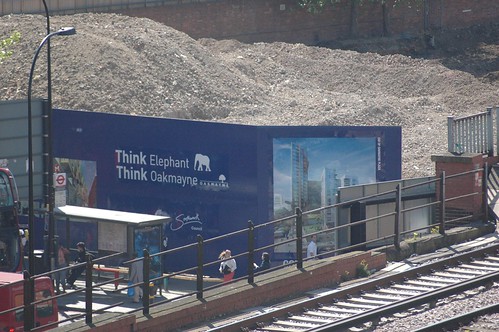
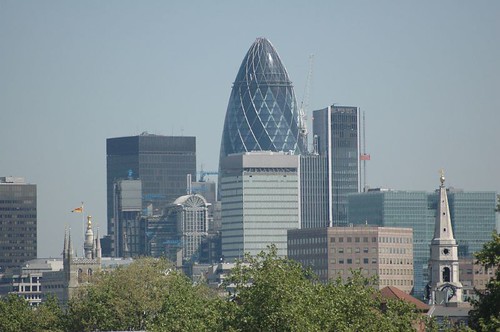
Elephant and Castle Regeneration: the view from my window

It's a bit noisy working from home at the moment as the building work begins:


Oakmayne Plaza Foundations

How long does it take to build something this size?


Still - we're luckier than these poor folks. No-one hurt, so I hear, but what a mess:

burnt out

Friday, April 27, 2007

The Heroine Den: Part 2

I've decided to resurrect this series of posts on the unsung heroines of science and tech (if one post so far can be constituted a series) despite the fact that I know it will be Troll-bait.

Aminollah Sabzevari from UBC is hero of the day for his piece in Science Creative Quarterly on the heroines of medical physics. Women are less unsung in Med Phys than they are in other domains (with the exception perhaps of the shoddy seeming treatment of Roaslind Franklyn). But my Auntie in Law (AiL) is a med phys who gets to shop for Linear Accelerators and the like. This post is in part a tribute to Auntie Rosemary - she rocks.

In honour of my AiL, and with thanks to Aminollah Sabzevari, todays Heroines are Marie Curie, Harriet Brooks, and Rosalind Franklin.

I'd also like to add another x-ray crystallography pioneer and Nobel Laureate Dorothy Crowfoot Hodgkin to the list.

Eppur si muove...[1]

Whaaaa?

[1] "Nevertheless, it moves..." statement ascribed to Galileo (by legend) after his forced retraction of heliocentrism.

Thursday, April 26, 2007

WOOT!

...as I believe the young people say.

I succumbed to temptation and bought an iPod nano and one of those Nike+ doohickeys at the end of last month. Two days later I entered my first challenge. Ten days later I had dreadful shinsplints. Now (and with only minor leg pain) I'm back and stronger than ever:


I've never come third in anything sporty before! I used to walk round at the back of the cross country with the smokers and a chip butty. I'm feeling a wee bit pleased. Ahhh, but for 300 m I could be second. I'm almost tempted to strap the trainers on again right now...

Tuesday, April 24, 2007

Dancing on the ceiling

Yay! The paper is in, the registration is confirmed and I'm going to GECCO! And as it's at UCL I get to go to a top conference without carbon angst - I can just go home to the hubby for a week.

Being run by those protestant-work-ethicy Americans, the conference runs for five days that include a Saturday and a Sunday. But how better to spend a sunny July weekend than in a tutorial on Evolutionary Multiobjective Optimization. And I'm about 85% serious when I say that.

The paper's only a late breaker - 8 pages on whether Evolutionary Multiobjective Optimization can help our robot intelligently plan experiments (spoiler alert: it can). But the cleverness of the paper is as nothing to the financial hoops I've jumped through to get this funded: half off for volunteering to help out (thank you local organiser and Publicity Chair Peter Bentley), got a further discount for registering to join SIGEVO, and got the rest funded as a staff development course. Amazingly it ticks all the boxes as a staff development course as there are tutorials and a careers workshop (well, job shop). So I get to save precious grant money for conferences my PI would rather I attend. As yet I've failed to ascertain what these might be, but I bet they won't be as carbon neutral as this one.

But can I let you in to a secret? Publishing the paper is a plus, the tutorials are a major draw and the job shop: what can I say, I'm a fixed term post-doc. But what is the main attraction? I get to be all groupie/stalkie over my favourite evolutionary biologist (no, not that one) Steve Jones. The gala event will be a Question Time style debate between Profs Jones, Dawkins and Lewis Wolpert. There was space on the registration form to record the question I would like to ask, but sadly I couldn't think of one[1]. Questions on religion were discouraged - possibly because of the strong similarities between the views of all three participants. Should be a fascinating evening nevertheless.

Steve Jones' talk at the Royal Society.


[1] Or at least not one I'd be prepared to utter out loud in the Natural History Museum! I am, after all, a married lady...

Monday, April 23, 2007

Sudden onset of respect for Katie Melua

About 13 minutes in (although the rest of the video is well worth a watch):


Take a look at the Simon Singh article in the Guardian that sparked the "rewrite".

I'd be much more likely to buy the revised version - especially if a sinoanthropovelecipedologist can give us a passably accurate number (with p-values) of bicycles in Beijing.

Video from TED.

Friday, April 20, 2007

~bleak U ~serious

This week has been short of cheerful posts. So, from Jessica Hagy's Indexed series:


Widgets available here.

It thinks with its brain now

Jeff Hawkins is one of those jaw dropping people who seem to have an amazing capacity to make things happen. He's the pioneer behind "pen based computing" and the Palm and Handspring companies.

More recently he's used his money and inventiveness to found the Redwood Centre for Theoretical Neuroscience, based at the Helen Wills Neuroscience Institute at Berkeley. From this, along with long term collaborator Donna Dubinsky, he's spun off a company called Numenta.

Why the business update? Well, Hawkins is of the view that current research in AI will never succeed in emulating "holistic" human intelligence. In that he's right. In the AI community, we're very good at solving particular problems (such as how to win at chess) and developing particular techniques (like the neural net or genetic algorithm). We have computers that are a lot smarter than computers "ought" to be - this area of research is known as "weak AI". We're also pretty good at using some of these intelligent modes of computing to better understand living intelligences, like human perception for instance.

Strong AI - making a computer that thinks like a human - has been a dirty word for some time now. The reins on this area of research were tugged in pretty sharply at the onset of the AI winter and have never been slackened since.

Hawkins may be about to change all that with his model of Hierarchical Temporal Memory (HTM). The details of his group's work can be found here and [PDF] here.

Hence the business update. I get my jollies from evolutionary computation and logic programming, so this is not my area. From the (very) little I do know about neurally inspired computing, this doesn't look like "neural nets 2.0". But I don't know: is this old news, a pipe dream, or the shot in the arm that brings "hard AI" back to life?

If I read something like this from any other entrepreneur I'd be cynical as all getout. On Hawkins' past form however, I'm downgrading that to merely sceptical. With an option on secretly hoping to be convinced.

And if all that was just too dry for a Friday - take a look at this "tutorial" on neural architecture:


(Spotted on Mind Hacks

Wednesday, April 18, 2007

Blaming the victim

[UPDATE 13:50 BST: The post below was written before the Metro changed their awful headline. It seems to have happened about an hour ago, judging from the comments on Feministe. I'm glad. I just wish that the bigotry behind it was as easily redacted]

I wasn't going to blog on the incomprehensible murders at Virginia Tech, or at least not yet. In a week or so I planned to review the posts on the various academic blogs that I look at [1]. After all, what do academics manufacture, if not understanding? Maybe between them all they could explain why what had happened, happened. But my hand has been tipped by two emails I received today.

I know that 1,000 times this number of people are killed in the US by guns each year. Each one of those deaths is a tragedy. How many of those deaths would still have occurred, had the gun not been readily available? I suspect it's much fewer. I honestly don't know.

Why do I personally find these thirty-some deaths so shocking? Because they happened on a university campus. I still have a naive hope that university campuses are places that young people go to discover life, widen their boundaries, and learn responsibility. When it turns out that all is not well in the Ivory Tower, it feels like the carriage I'm in just gave a sickening lurch.

I am incensed, if there is any truth to the reports, that the teachers of the young man responsible were ignored when they voiced their concerns.

The reason I'm blogging now is this: I received, one after the other, two emails that dealt with the aftermath of the incident. The first one was a press roundup, that covered how the shooting had been dealt with in the British media. Our tabloids have a penchant for the scarlet lady, the vile temptress, the fallen woman [2]. It seems they've found another one. The most nauseating of their endless, masturbatory speculation seems to have fixated on the young woman who was the first victim. Headlines include this from the Metro - a paper so bad they give it away for free:

Face of the Girl who Lead to Massacre


I'm physically shaking as I type this. I am so damn angry. This is but one headline, typical of the tabloid press today, particularly those owned by the D**ly M*il. The sneering implication behind all of them is that this "vibrant girl with an engaging personality" had brought this horror down on all the victims, by rejecting the romantic/sexual advances of the murderer. This is the overwhelming message spun by the our gutter press in the UK.

I'm appalled. I'm ashamed.


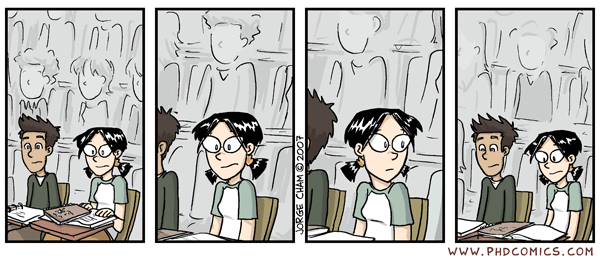
On to the second email. It was left to a (male) cartoonist to describe, so insightfully, the feeling of many young women on campus:

http://www.phdcomics.com/comics.php?n=850
(Image copyright Jorge Cham.)

I remember my own undergrad days with more clarity now. I was lucky - I've always been defensive and prickly. Those female friends of mine who made the mistake of being "vibrant girls with engaging personalities" ended up in some awful situations. I know at least one victim of rape, and two who had to endure months of terrifying and sometimes violent stalking. I'm reminded too of the Ecole Polytechnique gynocyde [3] in 1989. I'm forced to confront the fact that my naive view of the halcyon days of campus life are far removed from the truth for many students. Blaming the victims is sick.


[1] There is a useful roundup already on Cognitive Daily.

[2] q.v the current treatment of Heather Mills-McCartney, and Princess Di, pre-sainthood.

[3] "[The gunman] asked the women whether they knew why they were there, and when one student replied “no,” he answered: 'I am fighting feminism... You're women, you're going to be engineers. You're all a bunch of feminists. I hate feminists.' Lépine then opened fire on the students from left to right, killing six and wounding three others." From Wikipedia

Tuesday, April 17, 2007

Inventing temperature - a plug

Prof. Hasok Chang, a colleague from the Evidence Science project, won the 2006 Lakatos Award in Philosophy of Science for his book Inventing Temperature. If you're in London tomorrow (the 18th April) and can make it to the LSE in time, be sure to catch his talk. It promises to be extremely interesting.

Code of Conduct

Plenty of interesting fodder in the carnival (see post below), particularly in the light of the recent attention paid to the egregious posts - including those inciting sexually violent acts - on Kathy Sierra's Creating Passionate Users blog.

For my £0.02 (that's like what - $0.04 US at current exchange rates?) in the light of what's happened to Sierra and others, I appreciate where Tim O'Reilly's Code of Blogging Conduct (CoBC) is coming from. Briefly - there are 7 Principles O'Reilly suggests:

1. Take responsibility not just for your own words, but for the comments you allow on your blog.

2. Label your tolerance level for abusive comments.


3. Consider eliminating anonymous comments.


4. Ignore the trolls.

5. Take the conversation offline, and talk directly, or find an intermediary who can do so.


6. If you know someone who is behaving badly, tell them so.


7. Don't say anything online that you wouldn't say in person.


The notion of a Code of Conduct always raises the hackles of a woolly liberal like me. There's an instinctual belief that those trying to dictate acceptable behaviour will dictate the terms in such a way that it benefits them alone. But I think O'Reilly's done a sterling job here, though I'm not sure whether I'd call this a code of conduct. As you'd expect from O'Reilly they are a clear, interesting and useful set of how to's that will help make blogging more fruitful for those who choose to adopt them.

Principles 1, 2 and 3 are suggestions for good editorial practice, and the way they're implemented will vary from blog to blog. O'Reilly hat tips Kaylea Hascall for the notion of a set of Creative Commons type badges that will let readers know what "flavour" of comment you'll allow. Me - ad hominem attack are a nono; I'm relaxed about profanity; but absolutely no tales of some 16 year old babysitter killed by an axe wielding maniac or similar that conclude "if you don't post this comment to 15 other blogs you will die a horrible death". If someone can make me a succinct badge that conveys that I'll be eternally grateful!

Principles one and two kind of run together for me. If you have an editorial policy on your blog regarding the comments you'll allow then this should be made explicit. There's no point hoping that someone who's recently turned on to your blog will "get" the culture you're fostering. An explicit declaration of what will and won't be posted saves the blogger from a lot of whining from deleted posters whose amour propre has been damaged, and saves would be posters a lot of time and energy, if they know a priori what doesn't fly on your site.

Principle 3 has caused a bit of a ruckus in the blogging community. There are many (such as the fab NHS Blog Doctor) who can't divulge their identities for professional reasons, and others who can't or won't for personal reasons. However, I think that there are gradations of anonymity - there are those who know me in the "big room with the blue ceiling" that I wouldn't dream of giving my phone number to for example. A consistent online identity - even if it's nothing more than a username - is at least "fair dealing" when it comes to tying together a picture of who says what. I like Slashdot's default guest handle of "anonymous coward" - it's hard to upbraid someone about their behaviour if you can't see a pattern of behaviour emerging. For the purposes of a useful CoC, anonymity must allow you to retain as much privacy about your real life identity as you would retain in talking in any location where you might be overheard. Those posters who don't use a consistent identity - whether posting as "anonymous coward" or using endless sock puppets - should be taken about as seriously as a phonecall from a Mr "Haywood Djablomé".

I find 4 very hard - I think most serious bloggers, particularly the scientists and engineers, all do at some level. At the bottom is a difficulty in recognising some of the less obvious trolls. This is a result of my perplexity in not understanding how someone can be engaging in a discussion in anything less than a spirit of openness and goodwill. Thankfully I've never been high profile enough to have truly bothersome trolling. Maybe the Scientiae carnival will change all that...

5 and 7 will be ignored by trolls, but are at least good reminders for those of us who maybe just get a little het up sometimes. I know I prefer delivering the bad news about someone's diminished intellectual stature and personal effectiveness ("you're a jackass") in private than in public.

Number 6, read in conjunction with number 5, suggests that bad behaviour be tackled offline. One of the problems I've encountered in other forums is that trolls use this propensity for the "good citizens" to address the troll privately to divide and rule. The complainant is left with the impression that they're the only one that finds the behaviour to be out of line. It's only when the members of the forum can name the behaviour as being unacceptable in public that they realise they're not the only one having a problem with the troll in question. There needs to be some sort of corollary to 5 - when private communication fails, we have a right or perhaps a duty to calmly and dispassionately name the poor behaviour in public.

So I've been won over. The Code of Conduct looks reasonable and useful. It will only be noticed by the "good citizens" - but if nothing else it will empower us to name bad behaviour. The Internet is a public place - but so is the bus stop. You're having a edifying, enlightning or entertaining conversation, waiting for the bus. Some idiots keep barging in to make threats, or derailing the conversation with loud yelling. Not only that, they do so in disguise. You'd be happy to call the behaviour unacceptable. Don't settle for less online.

I've been Carnivalled!

The latest Scientae carnival has just been compiled at See Jane Compute. Big thank you to Jane, the editor. I've never had anything I felt was worth submitting in the past (though the video for Dog Police came close - someone out there must know how that freak of nature came about). This issue ciovered the topic of spring cleaning (or taking out the trash) - so I posted my rather bleak entry on my time as a lecturer (roughly equivalent to a US assistant professor I believe).

Long story short - I'm listed among such paragons as Post Doc Ergo Propter Doc, Pandagon and, currently top of my RSS feeds, Female Science Professor.

Hope to see some new faces around over the next few days. Welcome to Auntie Em's - help yourself to a cookie!

Tuesday, April 10, 2007

Nowhere to run to baby - nowhere to Hyde!

I'm sorry - I've become one of those annoying people who badger people for money: and I don't even have the decency to hang 'round the high street with a puffa jacket and a clipboard in order to do so. To the right you'll see a fancy-schmancy widget that will allow you to sponsor me to drag my sorry carcass 'round Hyde Park this autumn. Given that, in the aftermath of a 3km run, I currently have shin splints that would have caused Torquemada to exclaim "Oh I say, steady on", this is a bigger ask than it sounds!

Anyways - the money's going to Cancer Research UK - which is enough to put the shin splints into perspective. So cough up what you can and I'll try not to cough up before the finish line.

EDIT: No need to be as generous as David has been - now I know what it's worth to have me out of the flat!

Friday, March 23, 2007

Careering off the road

All the careers advice I see aimed at scientists, particularly women scientists, says "minimise teaching", "avoid administration", "be cutthroat about the committees you agree to join", "publish, publish publish", [pdf] "avoid the lure of the 'velvet ghettos'".

I used to think this was all overly cynical. Instead of a straight postdoc, or the lure of the industry and mamon - both of which were available to me after my PhD - I went into teaching in a new university. Full of the fires of idealism I embraced student contact time, I volunteered for committees and panels, I agreed to devise and run an new course. I relegated my research to evenings and weekends.

I had what I guess you might call a nervous breakdown.

I cried on Sundays, pretty much from the moment I got up, because of the thought of going to work the next day. I'd physically shake on the way into work. I forgot to eat - my body was so loaded with 'fight or flight' signals that mere drives like hunger and tiredness failed to register.

Sounds funny to say, but after the stresses of a PhD none of this seemed too strange. I don't think that either I or my husband realised at first what an awful trap I'd set for myself. I managed to grind out a couple of papers but I had no enthusiasm, no drive too do any research. It was only when I found myself contemplating "causing delays on the Northern line"[1] that we realised what a mess I'd got myself into.

I fled, a year ago, for the "straight postdoc" - even though I now only see my husband every other week, and spend 10 hours a week on trains.

Am I over it? Not entirely. Not yet. The thought of running a course, of being co-opted into being surrogate parent, agony aunt and punching bag for students makes me shake. I'm not sure that anyone who hasn't lectured can understand how it feels.

There are people (or so I'm told) that thrive on the teaching. There may even be those who find that teaching inspires their research as well as the other way around. But a novice, female lecturer will always attract this kind of awkward customer

I will plan to contest the grade you have given me in this class when I get it because I know it will be much higher with any other teacher. I am a very religious man and you are not a bad person but you do not choose your words with enough care like a teacher should. You try to be objective and the very attempt becomes your flaw because you try so hard to grade fairly and comment wisely that you become biased to your own ideas... You grade my papers poorly but do not realize that you do so because they reflect your teaching skills. Other people may have done well with your skills but I did not and would have talked to you but what you said about grading fairly made me uncomfortable.


As I read that I shuddered. The blogger who received this, Acephalous, still misses teaching. I don't.

I had 300 students on just one of my courses. Maybe only 15 to 20% were this bad. That's still 45-60 emails a week on average of this kind of mind numbing, soul sapping cant. "I didn't take the test because I didn't come to your lectures so I didn't know when it was", "I couldn't give my presentation because I forgot", "I don't like my grade. If you don't change it I'll complain".

It leaves you too tired to deal with the real problems: the student whose parents are pushing her into a marriage she's not ready for, the student who's had his jaw broken in a racist attack, the pregnant student who just needs an extra week on her assignment, because the morning sickness is so bad, the Chinese student whose English is poor and who is dreadfully lonely and is thinking of going back to China. In each of these situations, and a hundred more mundane, the coughs, colds and sniffles, you find yourself having to weigh up being supportive, just, encouraging and helpful. You end up acting as counsellor, arbitrator, judge and engineer: all roles I have no training for. The job so often requires the wisdom of Solomon.


I wasn't thick skinned enough. I couldn't develop the armour of cynicism that allows you to go home at the end of the day and say "not my problem anymore". I was trying to be, in the words of another Emma, the New Colossus:

Give me your tired, your poor, your huddled masses yearning to breathe free; send these, the homeless tempest-tossed, to me.


But I'm not made of such stern stuff as her.

I'm emerging - just. I'm starting to like research again. I'm starting to care about science. I'm starting to be mindful of the fact that my husband and I both have jobs that will let us, incrementally, add to the store of human knowledge. But I miss believing that, by being a lecturer, I'd have the peace and freedom to throw open that store to others.

[1] A euphemism - thankfully I never made it into this paper.


Thursday, March 22, 2007

Billy-an Logic

If you can print onto thin cardboard, and have a fiver to spare, consider investing in these very stylich Logic Goats.

And if you prefer your logic to be more philosophical than mathematical, ponder these answers from various strands of philosophy to one of the most pressing problems of modern human existence.

Wednesday, March 21, 2007

Food for thought

The Scientific American has an update on research that lead to the caffeinated donught, with suggestions for future research.

The "great global warming swindle" swindle

The brilliant, brilliant, brilliant, brilliant, brilliant Ben Goldacre reports on a fantastic article from the Indie on the (increasingly laughable) Channel 4 doc "the Great Global Warming Swindle" (GGWS).

To whet your appetite, here are Connor's graphs:


Martin Durkin, the writer and director of the GGWS, has form in this area. The ITC ruled that his 1997 documentary "Against Nature" (also for Channel 4)

"The programmes breached the Programme Code in respect of the failure to make the four interviewees adequately aware of the nature of the programmes, and the way their contributions were edited. The Commission directed Channel 4 to issue an on-screen apology to the individuals concerned."


Durkin's editorial fastidiousness is apparent for all to see in the Connor article:

[C]rucially, the axis along the bottom of the [Global Temperature] graph has been distorted in the C4 version of the graph, which made it look like the information was up-to-date when in fact the data ended in the early 1980s.

Mr Durkin admitted that his graphics team had extended the time axis along the bottom of the graph to the year 2000. "There was a fluff there," he said.

If Mr Durkin had gone directly to the Nasa website he could have got the most up-to-date data. This would have demonstrated that the amount of global warming since 1975, as monitored by terrestrial weather stations around the world, has been greater than that between 1900 and 1940 - although that would have undermined his argument.

"The original Nasa data was very wiggly-lined and we wanted the simplest line we could find," Mr Durkin said.


Very "wiggly-lined"? And Channel 4 pay this man to make science documentaries? They'll be paying Jade Goody to make documentaries on race relations next.

Tuesday, March 20, 2007

Ni Hao? No way!

I'm sufficiently seditious to be banned in China! I'm so proud!

Friday, March 16, 2007

Listen boss, I got a whisper of a blag going down in SW1

The DTI has ripped 68 million quid out of the ringfenced (hah!) science budget for the recompense of failed capitalists at Rover and BNFL. Us whitecoats have been worked over and no mistake. The villains claim that because the money is "only 1% of the science budget taken over the next three years" (significantly more than 3% for this year then, for those who can work out amortisation rates), it doesn't matter. Yeah right - I remember that defence working well in The Sweeney:


Regan:


[slams table]

Don't lie to me Wicks you bastard- you're the draughtsman[1] for this blag[2] - it's got your dabs[3] all over it!

Malcolm Wicks MP, Minster for Science, DTI (for it is he):

It's a fair cop Regan. I'll turn Queen's[4]. To be fair though - we only took 1% of what would have been in that peter[5] over the next three years.

Carter:

Oh well in that case boss, we'll just let him go


Regan:


Yeah, alright then, hop it. We're the Sweeny son, and we haven't had any dinner[6].

Carter:
[to Regan]

I fancy you meself in that moustache[7]


Regan:

[laughs, draws deeply on cigarette]

Gis a kiss![7]


[Cut to Credits]


Glossary for non afficionados of 70s cop show slang:
[1] Planner
[2] Theft, particularly of payroll
[3] Fingerprints
[4] Queen's Evidence
[5] Safe
[6] Actual dialogue from The Sweeney - Ser1 Ep1: "Ringer"
[7] Actual dialogue from The Sweeney - Ser1 Ep7: "The Placer"

Thursday, February 22, 2007

Get this one past the ethics committee

"Dr" Gillian McKeith[1] has famously claimed on many occasions that chlorophyll oxygenates the blood. She's the one that people like that mean ol' nastychops Dr Ben Goldacre[2] is forever banging on about. Well I've come up with an experiment that will silence the good "Dr"'s detractors for ever.

Since "Dr" McKeith has kindly shared her findings that Chlorophyll oxygenates the blood, I'm sure she won't mind being placed in a deoxygenated chamber with access to all the dark green leafy veg she can lay her hands on. This will demonstrate the effectiveness of chlorophyll as a blood oxygenator. Obviously she's not claiming you can get your full 550 litres of oxygen per day from chlorophyll (or at least I assume she's not). So perhaps a hypo-oxygenated environment would be better. Then the good "Dr" can demonstrate how the chlorophyll allows her to maintain her O2 saturation.

This is a potentially lucrative experiment too. She'd stand to make $1million US from the James Randi Educational Foundation (JREF). JREF is potentially the most generous research council in the world: $1million for a single experiment - you don't get that off the BBSRC[3].


[1]Thats '"Dr"', not 'Dr'.
[2]Thats 'Dr', not '"Dr"'.
[3] Not even if you're a Dr, not a "Dr".

Wednesday, February 21, 2007

Shame...

I'm a waste of bandwidth, people.

Contrast my post below with the ones at Heblog

OTOH, I can inform those who don't siarad the cymraeg that I have learnt that "manteision band eang" is Welsh for "the benefits of broadband". Not sure "Dog Police" is one of them...

What in the flinging, flying crap

This should probably go to Learned or Dreamed (please, please, say it was just a dream):


Maddest. Thing. Ever...