So I'm off - in a few hours I'll be in the air and on my way to Japan. I've done everything I can to prepare except pack - and I've become an adept at packing due to my commuter lifestyle, so I refuse to freak out about that. The smart shoes are re-heeled, the various language aids packed, the iPod charged and the sleeping tablets handy in my "sleeping on a plane" kit.
I wasn't going to post yet, but once aging, PhD comics seems to be talking directly to me. See panel 3:
Ho hum. I just hope the fame doesn't go to his head!
*Travels with Auntie Emma
Friday, September 28, 2007
Oba Emma No Tabi*


Thursday, September 20, 2007
It's not every day...
...I get excited about an inaugural blog post about smart devices
(If you're confused as to why I'm squee-ing, grep for "not here to review the iPhone".)
Wednesday, September 19, 2007
What a Crockus
Dan Hodgins coordinates the the child development program at Mott Community College. He seems to have some sound advice to parents about developmental stages of children. What he doesn't seem to do so well is neurophysiology. Which is a worry - as he's using it to prescribe educational interventions based on differences between the brains of the sexes that are, for the most part, of dubious significance, some of which are of dubious reality and in once case, are totally made up.
Dan Hodgins has a theory about the "Crockus" which, Hodgins claims, is four times larger in girls than in boys. Apparently, among other ramifications of the difference in size is that "Girls see the details of experiences" whereas boys see the broad picture. He even provides an unlabeled slide showing the size of the Crockus in girls and the size of the Crockus in boys. Strangely however, his slides don't actually show the Crockus - instead using the pars opercularis and the motor cortex as examples of the scale of this structure.
So where is the Crockus? Apparently - nowhere. No literature search/Google search/"shout out" to the neuroanatomy community has managed to find it. Prof. Mark Liberman of Language Lab had a theory. Maybe Hodgins misheard/misremembered "Broca's" or even "Pars Opercularis" as Crockus? Not wishing to just, y'know, hypothesise baselessly, Liberman emailed Hodgins, who replied:
Thanks for asking....The Crockus was actually just recently named by Dr. Alfred Crockus. It is the detailed section of the brain, a part of the frontal lope. It is the detailed section of the brain. You are right, it is four times larger in females then males from birth. This part of the brain supports the Corpus Callosum (the part of the brain that connects the right and left hemisphere. The larger the crockus the more details are percieved by the two sides of the brain.
For boys, usually they only view and analyze the whole picture, not the sum of its details. Girls brains are wired to look at the details first, which then leads them to the whole picture.
Look at the work by Moir.
You think that Liberman would be happy with that explanation, no? It's in the "frontal lope" [sic] - case closed. Over to persnickity Professor Libermann:
This deepens the mystery, I think, because I can't find any likely-looking Alfred Crockus via Google Scholar or Wikipedia or even general web search. I think that the "Moir" he's referring to is the co-author of Anne Moir and David Jessel, Brainsex, 1992. But Amazon offers its "Search Inside" feature for that work, and a search for "Crockus" in it comes up empty.
I have to say - I did find one kind of Crockus - and I would be quite happy if mine was four times bigger than yours! [SFW]
"Has this complete knob-end saved American democracy? "
The tasering of Andrew Meyer, a participant in a college Q+A session with John Kerry at University of Florida, has me baffled. I don't get Campus Cops. They seem to operate outside of any kind of control, have no accountability and be worse than useless
But this?
At 1'44" the mic is cut and instantly the police are on Meyer. In my previous experience people give up talking out of embarrassment no more than about 30 seconds after a mic is cut, so the instant response seems like bad crowd management.
Around 2'50" you can kear Kerry talking in the background. He says "Let me just say [that?]... because it's a very important question". Evidently Kerry has a) no beef with the question per se, and b) no intention of talking to the "law enforcement" present.
At 3 minutes in, Meyer is on the floor with several police on top of him. He asks what he did, and begs not to be tasered. At this point he is vociferous but not actually moving anywhere. 3 bursts of taser fire can be heard being "discharged" into Meyer.
In all seriousness, I've seen far more obnoxious questioners than Meyer at academic conferences, and political events, before. Never seen any of them end up on the receiving end of a police action, violent or otherwise. Even this egregious overkill was at the hand of rentabrawns. I have to say, the tasered chap was up there for pomposity and pushiness, but that's not the point.
Guardian Unlimited Talk is leaning towards the POV of the taser-happy cops, surprisingly[1]. I think it's more because we brits find pompous windbags insufferable, and not because we think that free, all be it a bit whiny, speech is a taserable offence. Post 118 sums it up best:
"YusufAlBinDoonrapub - 05:27pm Sep 19, 2007 GMT (#188 of 202)
"Has this complete knob-end saved American democracy?"
[link whilst it lasts]
Totally brilliant: that comment sums up the masterly balance/total fence sitting for which Guardian readers are justly famed. Someone else suggests that he should have yelled "Now we see the violence inherent in the system".
UPDATE:
Bartlebooth - 07:54pm Sep 19, 2007 GMT (#264 of 314)
...What did he do that warranted being asked to leave? Dragging someone away for asking Kerry, of all people, a waffly, confused question seems like the acme of dramatic irony.
[1] The Guardian is the left leaning broadsheet in the UK. It's readers are known for being sandal wearing, muesli eating, bike riding liberals[2]. The Guardian Unlimited Talkboard (GUT) is divided into two factions - the Guardianistas, and the right wing reactionaries who hate everything the Guardian stands for. Sometimes, however, an extremely funny one slips through
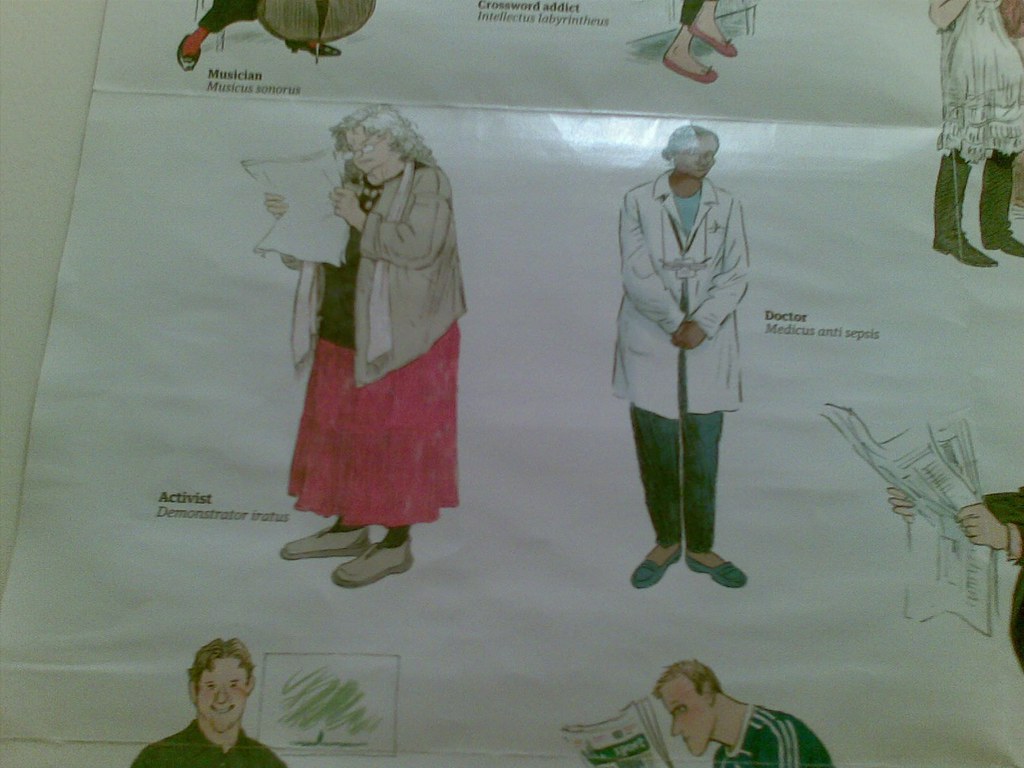
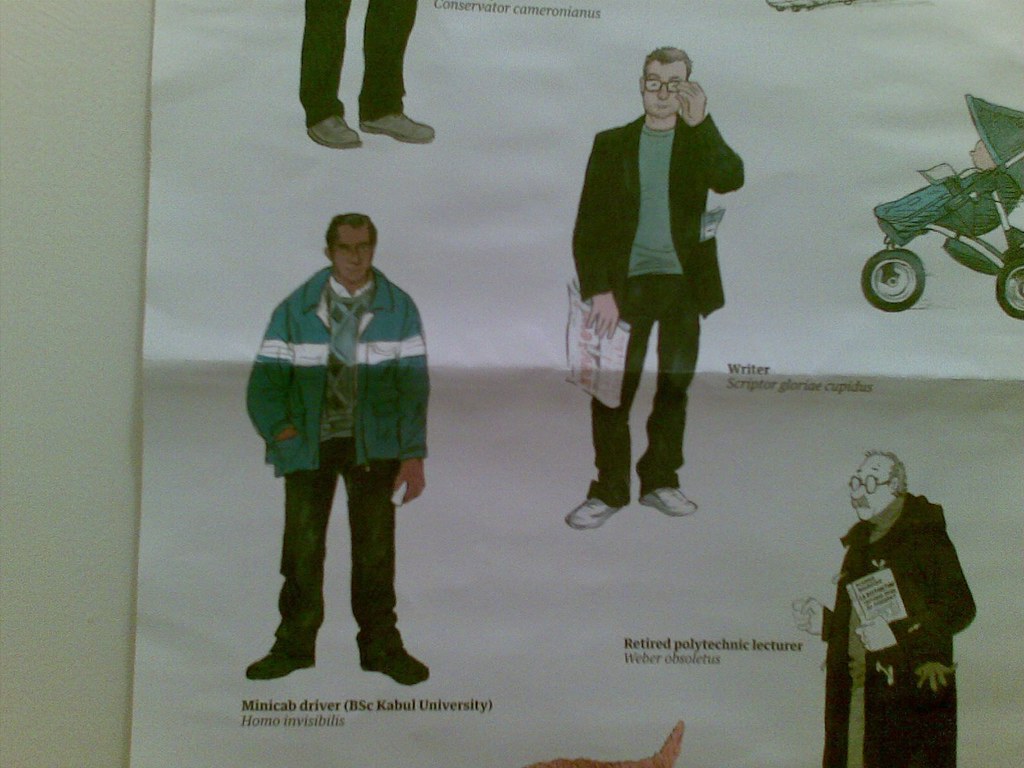
[2] It may confuse visitors from the USA in particular, that the term "woolly liberal" is not tantamount to the term "baby eating satanist" over here. The Guardian likes to send up its own image and did so with a fantastic wallchart, by the talented Posy Simmons, featuring stereotypical Guardian readers. Done with TFIC, the chart was a straight up parody of the nature wallcharts that they introduced to the UK Newspaper market in 2006. Guardian readers are, usually, secure enough in their liberalism and even sometimes, (whisper it), socialism, to be able to self satirise. One of the many reasons why I find the Guardian very comforting in these insane, taser-ridden times.
Sunday, September 16, 2007
5km today, 26.2 miles tomorrow[1]
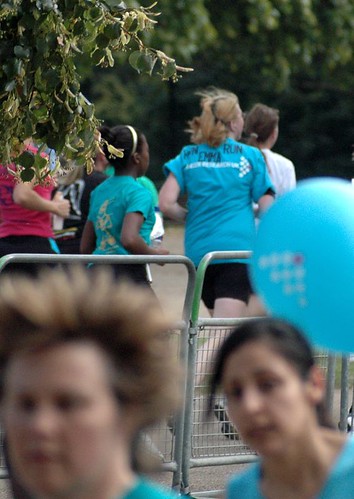
I completed the Hydroactive Women's 5km in a pretty respactable (for me) 29 minutes dead on. The T-shirt was meant to inspire me by making me think of Lola. Instead, I ended up thinking about Simon Pegg. It did the job though - no need for spatulas - and raised over £300 for Cancer research.
[1]Where "tomorrow" = April 2008, if I get a place... Or April 2009. Or I may come to my senses...
Friday, September 14, 2007
My Kind of Science
From The Onion:
Scientists Isolate Area of Brain That Doesn't Like Poking.
Even The Onion's science stories are better than the guff spewed out by some "real" newspapers.
Friday, September 07, 2007
"I made this" [1]
Happy days...
[1] Mad props to the first person to correctly identify what production company used a small child saying this as their ident, and at the end of which programme it used to be.
Auntie Em is now mobile...
Using Kaywa's Feed2Mobile service, my blog now comes slimmed down for mobiles. The QR code on the right can be captured on a camera phone with Kaywa's QR-Reader or similar. QR codes are fun!

Thursday, September 06, 2007
She's rational/he's a flake...
There seems to be a common point of view that women are more susceptible than men when it comes to new age woo-woo (and indeed old age woo-woo: horoscopes, homeopathy and the like). Men are the rational ones, we're more... "intuitive" (read: flakey, gullible, and prone to uncritically accept answers that "just feel right").
I've often wondered if this has any basis in fact. After all - for every Randi there's a Uri, and 66% of the very rich UK fortune tellers I can name, are men: Jonathan Cainer and Russel Grant for the guys, Mystic Meg for the gals. Maybe the "XY = rational, XX = addlebrained" divide is just the way the media plays it. Are all the loopy guys, and rational women, hiding?
Well, my suspicions were further piqued on receiving this email:
I am contacting you from [TV Channel]. We are producing a new programme called [Hopelessly Derivative Programme Name] and I was wondering if you might know someone who would like to take part. The premise of the show is opposites attract. We are looking to match people together who have different viewpoints so there will be interesting discussion and have them spend a long weekend together to see if romance [1] can take place over opposing views.
We are looking for a sceptic man in his 30’s and 40’s to be on the show.
Do you know any sceptical single men who might be interested? ...
Let me know if you need any more information
I look forward to hearing from you
Best wishes
[Researcher doomed to work for terminally unimaginative program execs][2]
Now I may be wrong - they may also be matching a new-agey man with a rational-chick (I'd volunteer but I'm off the market). Maybe they tried it the other way round, but smart women are much prized by smart partners, and we're all off the market by now. Perhaps the dumb bunnies are all that's left. But I have a sneaky feeling that they believe idea of matching, say, one of the Skepchicks with this guy[3] would be too much of a stretch for their viewers.
[1]For some reason I hear "romance" in scare quotes...
[2]My words, not the researchers - though I wonder if in her heart of hearts she wonders if this is what the masters in Elizabethan literature was for...
[3]Or heck, Randi and Uri - I'd Tivo that!
Wednesday, September 05, 2007
London by Leg
The last few days in London have been blighted by Tube strikes, due to the failure of cowboys PFI contractors Metronet. One of the presenters of Radio 4's Today Program was more than usually snippy about the notion of walking to work in London.
I guess if you have to arrive in time for a 6am broadcast you might never have walked to work - but there's something satisfying, and very pleasant about walking in, even when the Tube is running. It's certainly more fun than the mobile sardine-tin that is the Northern Line at peak hours. DH and I used to walk to and from work, in Bloomsbury, from our home in Elephant and Castle - a journey that more or less spans the whole of Zone One. It gave me time to ponder the day ahead/just gone and included a very pleasant five minutes (yes really, five whole minutes) crossing Waterloo Bridge. Even to this day DH tends to walk to work at Old Street.
It's free exercise, valuable thinking time and saves a lot of carbon compared to car or taxi. The charity Living Streets is trying to make walking as pleasant and easy as possible. As well as their own initiatives, they've linked to this alternative Tube map showing average walking times between Tube stations, created by students from Central Saint Martin's. For point-to-point walking maps, together with time, calories and carbon saving data, Walk It is also excellent.
Did you know?
- King's Cross to Bank - takes from 30 minutes, burns up to 173 calories and saves almost 10 kg of CO2 a week compared to taxis.
- Paddington to Hyde Park Corner - takes from 22 minutes, burns up to 130 calories and 7.4kg CO2 a week less than a taxi.
- Waterloo to Westminster - takes from 12 minutes, burns up to 72 calories and 4.1kg CO2 a week less than a taxi.
Tuesday, September 04, 2007
The joys of Evo-Psy
At the GECCO debate (audio and video available here, Steve Jones described a little game he plays with his undergrads, in which they have to come up with an evolutionary hypothesis for a facet of human behaviour or biology beginning with every letter of the alphabet. His "hypothesis" for blushing is cleverly designed to make women blush, and his description of the evolutionary benefits of zoophilia would get me thrown out of Aberystwyth University (formerly the University of Wales, Aberystwyth). The point he was making was that these evolutionary fables are diverting and very plausible-sounding, but are ultimately untestable.
It seems that, whilst I was away, the bad science of evo-psy reared its head again, this time on the evolutionary basis of the "preference" for pink vs blue for girls vs boys. Let us turn once again to the acerbic Ben Goldacre who critiques the study. Read the article, and consider the sartorial choices of Alice, Cinders and Bo-Peep.
The Truth is worth more than an iPod.
Wednesday, August 22, 2007
Unleashing my incompetence
Professor Shinohara of Tohoku University, Japan, has kindly agreed to let me join his group for a long visit. This is exciting, and the opportunity of a lifetime, but it also throws up some uncomfortable facts about how I see myself and the things I do to cope with the limits of my competence.
Coming from a chaotic family background, competence has always been hugely important to me. I've not minimised its importance by choosing to work as a woman in a male dominated discipline. Jorge Cham sums up pretty much how I feel most of the time in this strip:
Ever since school reports I've been described as "dilligent", "studious", "competent" and "enterprising". Solver of problems. Learner of things. Nose in a book, head in the air, feet on the ground.
So working in Japan for a month is going to be a huge challenge for me on a personal as well as a practical level. Regular readers will have noticed that I'm already trying to prepare. I'm learning as much Japanese as I can, downloading street maps, buying city guides and pumping every Japanese person I meet for data.
It's starting to dawn on me that being able to control my environment by knowing everything about it will be impossible. At some point in the next four weeks this has to stop, as it's more than bordering on an obsession.
My drive for competence has - not for the first time - reached its limit. This time, however, I'm going to try something new. I'm going to try letting myself be incompetent. Get in the Onsen the wrong way? Embarrassing sure, but really the end of the world? Use "Taberu" not "Tabemasu"? No-one will be rendered catatonic by my breach of etiquette.
And yet the mere thought of these faux pas is enough to render me clammy handed and weak legged. The thought of being incompetent is bad enough. The though of being the incompetent representative of womankind is enough to give me the screaming abdabs. I'm sent rushing back to Google, the Rough Guide and the friendly waitress in the Japanese restaurant.
I forever miss the moment because I've rehearsed it so many times, in order not to get it wrong. If I could unleash my incompetence, how liberating would it feel?
scientiae-carnival

Learning Japanese: 見せしめ 四
(Miseshime Shi/Lesson Four)
Last night David and I went to Hazuki Japanese restaurant.
I tried とんかつ (tonkatsu - deep fried beef), which was nice. But my favourite were the (considerably healthier!) nigiri (にぎり). Nigiri sushi are the little "bricks" of vinegared rice with a small fillet of raw fish laid on top.
Our incredibly helpful waitress supplied the Japanese names and the Kanji of the two fish that I ate. She helpfully explained that the names for most of the fish are rarely written out in Kanji, as they all contain the Kanji for fish (魚) and thus get quite complicated quite quickly. Salmon is an exception - the kanji is 鮭, and is said 'sake'.
The two nigiri I particularly enjoyed were the 'horse mackerel' and the 'eel'.
Horse mackerel: Aji - あじ - 鯵
Eel: Unagi - うなぎ - 鰻
Hazuki's menu helpfully lists all the names of the dishes in katakana/kanki as well as english. I'll be printing this out to take with me - and I may have a few more "practice runs" there before we go. I take my research very seriously you know...
Monday, August 20, 2007
Needles(s) activity
I decided to teach myself how to knit - relying heavily on the people at Knitting Help to find out how to cast on nicely. The reason? Innocent's Big Knit in aid of Age Concern. It's amazing - I've gone from never having touched a pair of knitting needles (or at least not since the jumbo sized ones you're made to play with in infant school "craft" lessons) to knocking up 2 small hats per evening.
Here are a few of my creations so far (now in blurryvision!):
But it's time to move on to bigger projects. I've already knitted myself an i-Pod Nano case in fetching lilac and purple. But David is now asking for something he saw over at Aphra Benn's place:
How to knit a Moebius scarf from the middle to the edge.
I'll start that when I've decided I've done enough hats.
And after that, brains..?
Monday, August 13, 2007
Learning Japanese Part 3
Part 2 of this series of my notes on learning Japanese introduced verbs and the formal and informal present tense inflections. I've also been learning the past tense.
Remember that all uninflected verbs end in a u:
書 to write Kaku (かく)
考 to think Kangaeru (かんげる)
来 to come Kuru (くる)
There are three "forms" of verbs.
1) Irregulars: of which there are only two: 来 and する (suru - to do)
2) All others ending in "ru": 考
3) All the rest: 書
Here's how to make the past participle of these verbs:
1) Formal: 来 becomes 来ました ("kimashita"); する becomes しました
1) Informal: 来 becomes 来た ("kita"); する becomes した ("shita")
2) Formal: -ru, +mashita: 考 becomes 考えました ("kangaemashita")
2) Informal: -ru, +ta: 考 becomes 考えた ("kangaeta")
3) Formal: -u, +imashita: 書 becomes 書きました ("kakimashita")
3) Informal: Now it gets trickier.
3i) if the verb ends in "ku", -ku, +ita (書 becomes 書いた - "kaita")
3ii) if the verb ends in "gu", -gu, +ida :
急 (いそぐ "isogu", hurry) becomes 急いだ ("isoida")
3iii)if the verb ends in [nu|bu|mu], -[nu,bu,mu], +nda
学 (まなぶ ”manabu"、learn) becomes 学んだ ("mananda")
3iv) if the verb ends in "su", -su, +shita
試 (ためす ”tamesu”, to experiment) becomes 試した("tameshita")
3v) all other "u" and "tsu", -[u|tsu], +tta
立っ (たつ "tatsu", stand) becomes 立った ("tatta"). Note that the つ ("tsu") character in the uninflected verb is not removed - it becomes the first "t" in った ("tta").
These forms are the same for all "persons" - that is, "I have written" is is "kaita" or "kakimashita". But "you have written" is also "kaita" or "kakimashita"
Friday, August 10, 2007
Learning Japanese, I really think so - part 2
Hurrah - it's official. Professor Shinohara of Tohoku University has kindly agreed to let me come for an academic exchange visit in October. I will join is group for a few weeks, which is an exciting, if somewhat terrifying, prospect. Rob seemed to enjoy the perplexity of the whole experience. Learning a little Japanese would, it seems, be essential.
So today let's look at verbs and versions of the present tense. It seems that things are a lot more straightforward than I'd feared.
All uninflected verbs end in a "u":
飲 to drink Nomu (のむ)
食 to eat Taberu (たべる)
来 to come Kuru (くる)
There are three "forms" of verbs.
1) Irregulars: of which there are only two: 来 and する (suru - to do)
2) All others ending in "ru": 食
3) All the rest: 飲
Among "informal' company, the present tense is simply the uninflected form of the verb. In more polite situation, the verb ending changes according to one of the following rules:
Type 1: These become "kimasu" (来ます) and "shimasu" (します) respectively
Type 2: Drop the "ru" and add add "masu": 食ます = tabemasu: I eat - politely ^-^ )
Type 3: Drop the "u" and add "imasu": 飲います = nomimasu: I drink, politely)
Next up - the past tense: in which we learn that there are seven rules for informal speech and only three for formal speech. This leads to a shaky hypothesis about why the Japanese tend to politeness.
Thanks to Amanda (アマンダ) and this webpage by Namiko Abe.
Thursday, August 09, 2007
Writing in Japanese fonts on OSX
In an earlier post I talked about the three Japanese character systems. Writing in Hiragana and Katakana is good practice for learning the sounds and vocabulary of Japanese. Here's how to do it on OSX:
- Go to system preferences: international: input menu
- Tick the Kotoeri check box, and the "show input menu in menu bar" box
- You'll see a little flag or icon in the menu bar - clicking on this brings up the list of available input types
- Select "Hiragana" or "Katakana". Each time you type a valid phoneme ("ka", "ta", "e","ni"...) it is automatically changed to the Hiragana or Katakana character.
So my name, in Katakana, is: エマ
The Knights who say "Ni" are the Knights who say ニ
And so on...
With love from アンチエム
Kilometre-stone
I'm measuring my runs in kilometres cause it feels so much, well, more than in miles, and today, after 68 runs, my Nike+ dohickey gave me the following
A pretty 250 KM certificate.
Still time to sponsor my 5k run for Cancer Research. Thanks to fantastic friends and family I'm now at 122% of my target, but the more we can raise for Cancer Research the better, so don't let that put you off.
Wednesday, August 08, 2007
Learning Japanese - I really think so
I am trying to learn Japanese (there's a reason - I'll explain some other time). I know the "Romaji" (romanised spelling) of some common Japanese words ("konnichiwa", "domo arigato mister roboto", that kind of thing). But a ma-hoosive impediment to getting any further is not understanding any of the several written forms of Japanese. So I'm teaching myself the Hiragana - the phonetic "alphabet" for anything other than common names (which have a different alphabet of their own).
Note that these symbols are not related to the Chinese derived "Kanji", which my reading tells me have, usually, at least two readings - a Chinese derived pronunciation (or pronunciations) called "On'yomi" and a reading derived from the original pronunciation of that word in Japanese called "Kun'yomi". The different readings are given in Hiragana in dictionaries, so knowing Hiragana is a huge advantage to learning what the Kanji mean, or at least how they are said.
Hiragana are also used for the "grammar" of Japanese, so I'm told. So learning these, and some basic vocab, is my first task.
Thankfully there are a small number of Hiragana and each maps to a Japanese phoneme. This is the first bit of good news I've had since deciding to learn some Japanese!
Here are today's words and the relevant Hiragana:
ありがとうございます (arigato gozaimasu: "thank you" from this online dictionary)
あ a
り ri
が ga
と to
う u
ご go
ざ za
い i
ま ma
す su
こんにちは (konnichiwa - written konnichiha: "hello". Literally means "today is".
こ ko
ん n
に ni
ち chi
は ha
ごくろさまでした (gokurosama deshita: "Thank you for your help" (lit: it must have been a toil))
ご go (note the "Daku-ten" accent (looks like a ") that turns "ko" into "go")
く ku
ろ ru
さ sa
ま ma
で de (another daku-ten - changes "te" to "de")
し shi
た ta
ごくろさま (gokurosama = it is a toil)
でした (deshita = past participle)
じゃまた (ja mata: see you later (from these useful lessons))
じゃ ja (the Hiragana for ji (じ) - which is in turn a shi (し) and a ", and a little version of the Hiragana for ya (や))
ま ma
た ta
せんせい (sensei: teacher or other highly placed professional - literally "one who lived before". From Wiktionary
せ se
ん n
せ se
い i
I still don't know how to punctuate or capitalise. Do such things exist? Any help appreciated!
'Til next time, ありがとうございます and じゃまた
Monday, August 06, 2007
Subscribe to:
Posts (Atom)